By Daniel Yeoh · OEM Sourcing & Supply Chain Writer · Published 4 Sep 2026
Every few months a Malaysian founder asks me the same question in a slightly different form: can we get our skincare made in Switzerland, and would it be worth it? It is a fair question. “Swiss Made” still carries weight on a Malaysian shelf and on Shopee listings, and Switzerland genuinely has a working population of cosmetic contract manufacturers — not just marketing offices attached to factories somewhere else. This guide names ten of them, with their real locations and websites, and then does the part most listicles skip: what it actually takes to bring their output into Malaysia, notify it with the NPRA, and sell it profitably.
Read this as a sourcing assessment rather than a shopping list. Switzerland sits at the expensive end of the global cosmetic OEM market, and for many Malaysian brands the honest answer is that a local or regional factory serves them better. But for a specific kind of brand — premium positioning, high margin per unit, a story that needs a country of origin — the maths can work. The sections after the company profiles set out when it does.
Key takeaways
- Switzerland has a real contract-manufacturing base concentrated in Vaud, Bern, Zürich, Valais and St. Gallen — ten verified companies are profiled below with working websites.
- Swiss unit costs are structurally higher than Korea, China, Thailand or Malaysia. You are buying formulation depth and a legally protected origin claim, not a competitive price.
- Importing into Malaysia still requires NPRA notification through Quest3+ regardless of where the product was made — a Swiss GMP certificate does not shorten that process.
- Halal is the biggest practical gap. Switzerland has very little halal cosmetics certification infrastructure, and a certificate must come from a JAKIM-recognised body to be usable here.
- Sea freight from Europe to Port Klang typically runs several weeks door to door, so a Swiss supply chain needs deeper safety stock than a Klang Valley one.
Why Malaysian brands look at Switzerland at all
The pull is almost always positioning. A cream that says “Made in Switzerland” on the carton reads differently to a Malaysian consumer than one that says “Made in Malaysia”, and in the premium tier that difference converts. There is also a substantive side: Swiss laboratories have a long tradition in actives, emulsion science and dermatological formats, and several of the companies below have been formulating on the same site for fifty years or more.
What Switzerland does not offer is volume economics. Labour, energy, packaging and regulatory overhead all sit at the top of the European range, and the Swiss franc has been strong against the ringgit for years. If your product competes on price in a crowded category — body wash, basic toner, mass-market sheet masks — a Swiss factory will price you out of your own shelf. The brands for whom this works are typically selling above RM150 a unit with room in the margin for a longer, costlier supply chain.
Is “Swiss Made” something you can actually claim?
This deserves its own paragraph because it is where Malaysian brands most often get caught out. The Swiss indication of source is legally defined, not a marketing convention. For cosmetics, the rules require that a substantial majority of manufacturing costs and of research, development and production costs arise in Switzerland, and that the quality-determining manufacturing steps happen there. Filling imported bulk into a bottle in Zürich does not earn the claim.
Practically, that means you should ask your prospective supplier, in writing and before you commit to development, whether your specific formulation and packaging plan clears the threshold. If it does not, you have paid a Swiss price for a product you cannot market as Swiss — the worst of both worlds. A supplier that answers this question crisply is telling you something good about how it runs the rest of its documentation.
The ten Swiss manufacturers worth knowing
Listed alphabetically. Each company’s website was checked and screenshotted on 4 September 2026. Details are as published by the companies themselves.
alpinacos AG
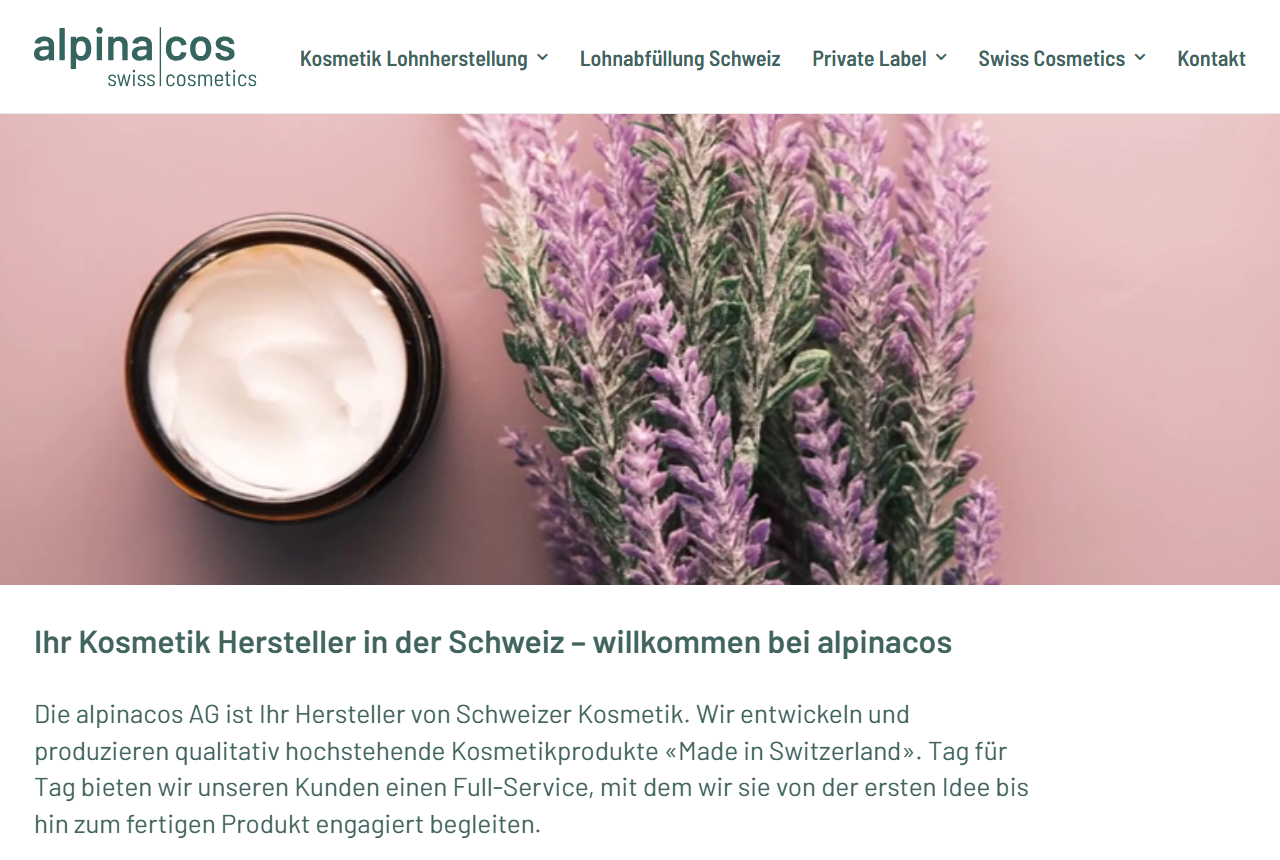
HQ: Kägiswil, Obwalden (production in Büron) · Type: Full-service contract manufacturer and private label · Best known for: Natural and functional care made in Switzerland
alpinacos runs the whole chain in-house: recipe development from its own library or from your brief, production, filling, labelling, assembly and dispatch. For a Malaysian brand that wants a single accountable partner rather than a chain of subcontractors, that matters more than it sounds. The site is German-first, so plan for English technical documents to be requested rather than assumed, and ask for the certificate scans up front — the homepage refers to industry-standard certification without naming the standards.
Cosmetolab SA
HQ: Wädenswil, Zürich · Type: Cosmetics laboratory and contract manufacturer · Best known for: Natural-active skincare, operating since 1949
Cosmetolab leads with formulation rather than filling capacity, working from a stated bank of over 250 natural actives and covering production, packaging, quality control and logistics behind it. Output is presented as vegan and cruelty-free with batch traceability. It suits a brand whose selling point is a particular active or texture and who wants a laboratory conversation, not a catalogue conversation. No certifications are named publicly, so put GMP documentation on the agenda for the first call.
Cosmotec
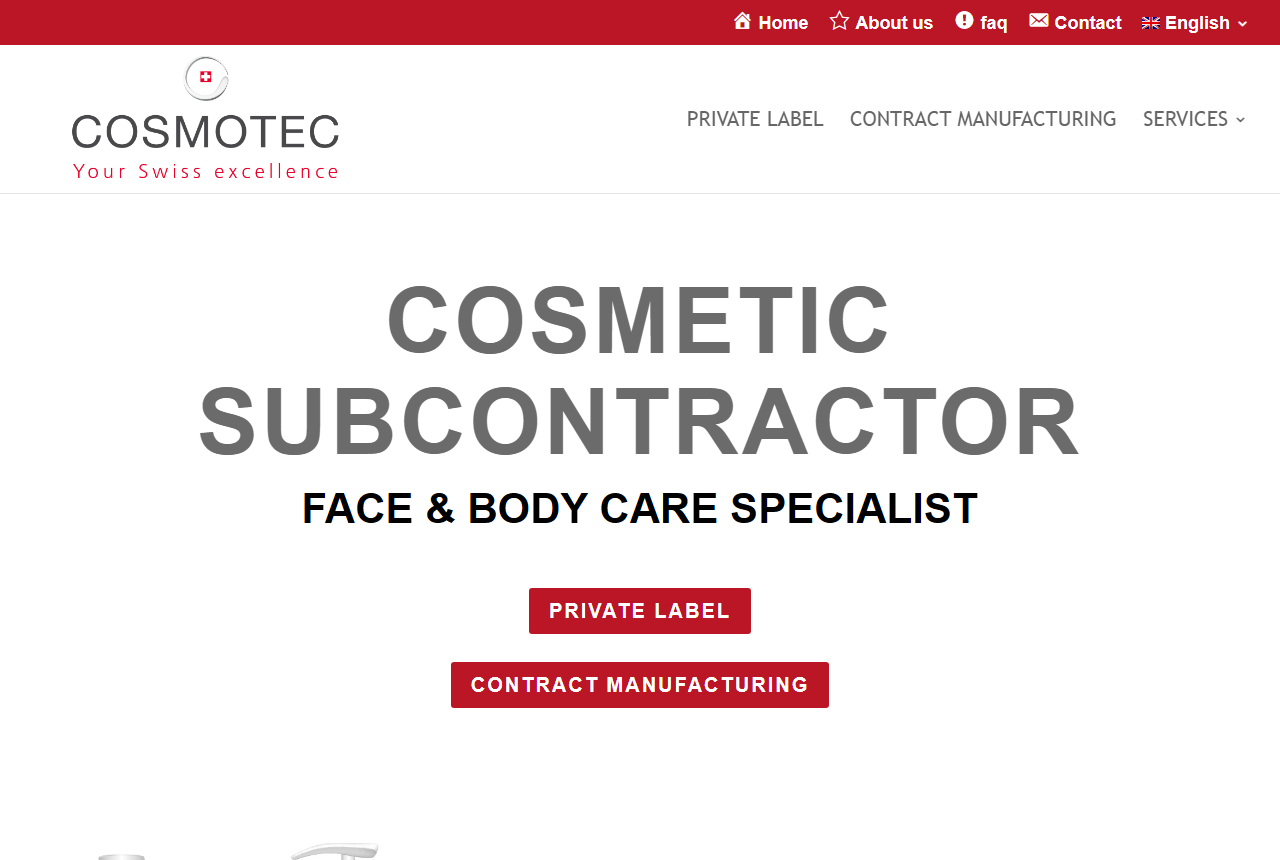
HQ: Vouvry, Valais · Type: Cosmetic subcontractor and private label · Best known for: Face and body care built around Alpine spring water
Operating in the Valais since 1988 and citing ISO 22716 GMP, Cosmotec covers private label, custom formulation, in-house R&D, regulatory assistance and logistics. The Alpine spring water angle is a ready-made product story for a Malaysian premium launch, and the named GMP certification makes the NPRA documentation conversation simpler. Its centre of gravity is face and body care, so a broad multi-category range would need a second supplier alongside.
Frike Group
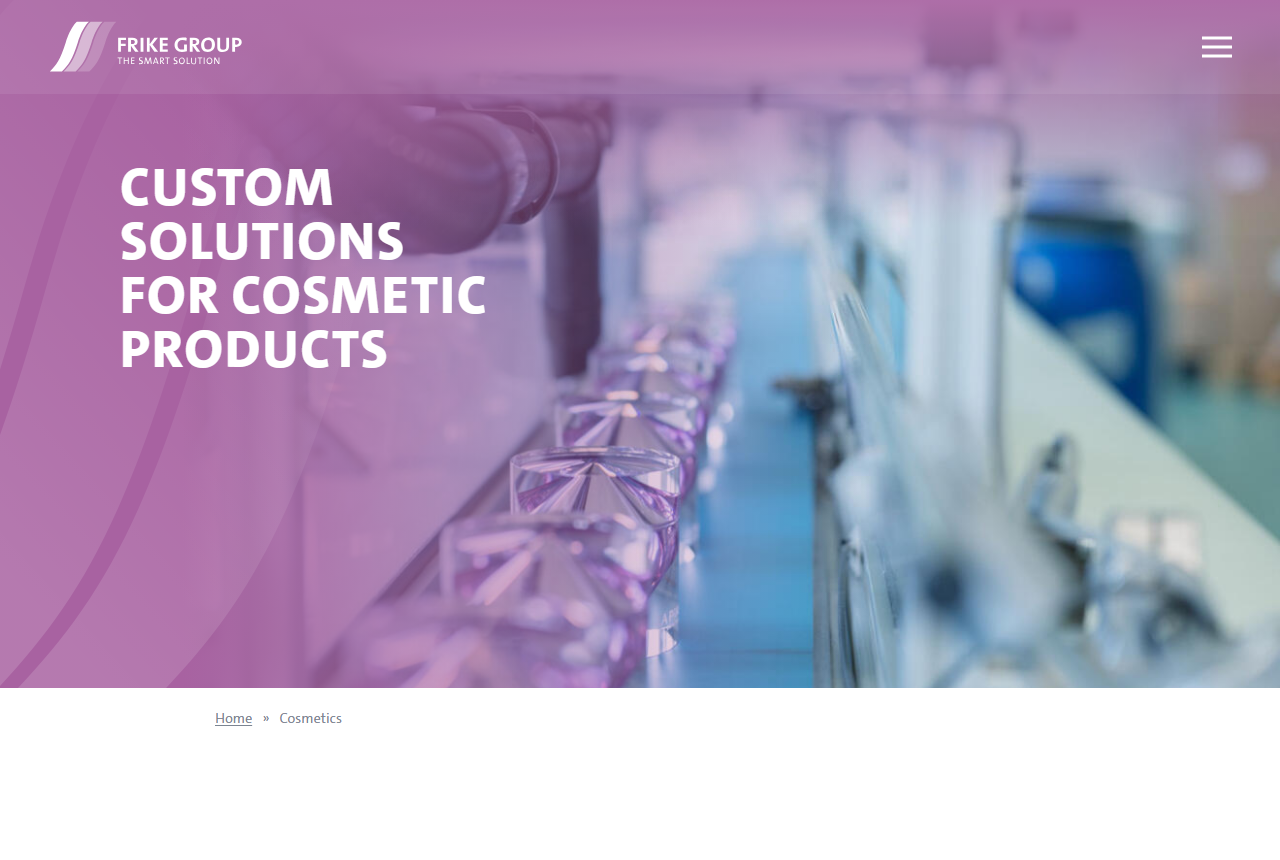
HQ: Mönchaltorf, Zürich · Type: Contract manufacturer and filler · Best known for: Aerosols, foams and sprays alongside conventional emulsions
Frike is the format specialist of this group, filling aerosols as foams, sprays and gels plus creams, emulsions, oils, powders, pastes, serums and waxes into containers from 50 ml to 3 litres. It publishes ISO 9001, ISO 22716, COSMOS and EcoCert certification. One caution specific to Malaysian importers: aerosols are dangerous goods, which changes your freight options, raises the cost per unit and adds paperwork at Port Klang. Factor that in before you fall in love with a mousse format.
Intercosmetica Neuchâtel SA
HQ: Neuchâtel · Type: OEM private label and full-service ODM · Best known for: Long-established Swiss skincare contract manufacturing
Intercosmetica states more than sixty years in the industry and holds ISO 22716:2007 and ISO 9001:2015, covering formulation, filling and packaging for skincare. It sits within the Zepter International group, which gives it more corporate stability than the boutique laboratories here. For a Malaysian brand assembling an NPRA notification, named and versioned certifications are worth real time savings. Ask about capacity allocation, since group-owned factories run internal programmes alongside external clients.
M. Opitz & Co. AG
HQ: St. Gallen · Type: Contract manufacturer, filler and private label · Best known for: Cosmetic and pharmaceutical production on one site
Founded in 1965 and now in third-generation family hands, M. Opitz develops, produces and fills both cosmetic and pharmaceutical products, stating ISO 9001, ISO 22716 and Swissmedic pharmaceutical GMP. That dual position is unusual and useful if your roadmap includes anything that might edge toward a medicinal claim — a distinction Malaysian regulators take seriously, since a product that crosses into drug territory leaves the NPRA cosmetic notification route entirely. Expect a relationship-led, German-language process.
MySwissLab+
HQ: Forel · Type: Private label, white label and custom formulation · Best known for: Low minimum quantities and colour cosmetics
This is the most accessible entry point on the list for a smaller Malaysian brand. MySwissLab states ISO 9001:2015 accreditation and ISO 22716 cGMP adherence, publishes a private-label starting point around 100 units, and covers makeup and hair care as well as skincare. It also runs microbiology, preservative-efficacy and stability testing in-house and prepares safety reports — genuinely valuable, because those documents feed straight into your Malaysian notification file. It is the youngest company here, dating its work from 2018, so ask for category-specific references.
Swiss Cosmetic Technology (SCT)
HQ: St-Prex, Vaud · Type: Contract manufacturing and private label · Best known for: Professional-use and clinic-channel formulations
SCT states over thirty years in the industry with pharmacists and physicians on the team, producing serums, creams, gels, oils, lotions, soaps and shampoos across consumer and professional ranges, and advertising a private-label range inside roughly three months. If you are selling into Malaysian aesthetic clinics, medispas or salon networks rather than retail, that channel experience is worth more than a small price difference. Certification appears as logos rather than named standards, so request the documents before briefing a formulation.
Swiss VitalCare GmbH
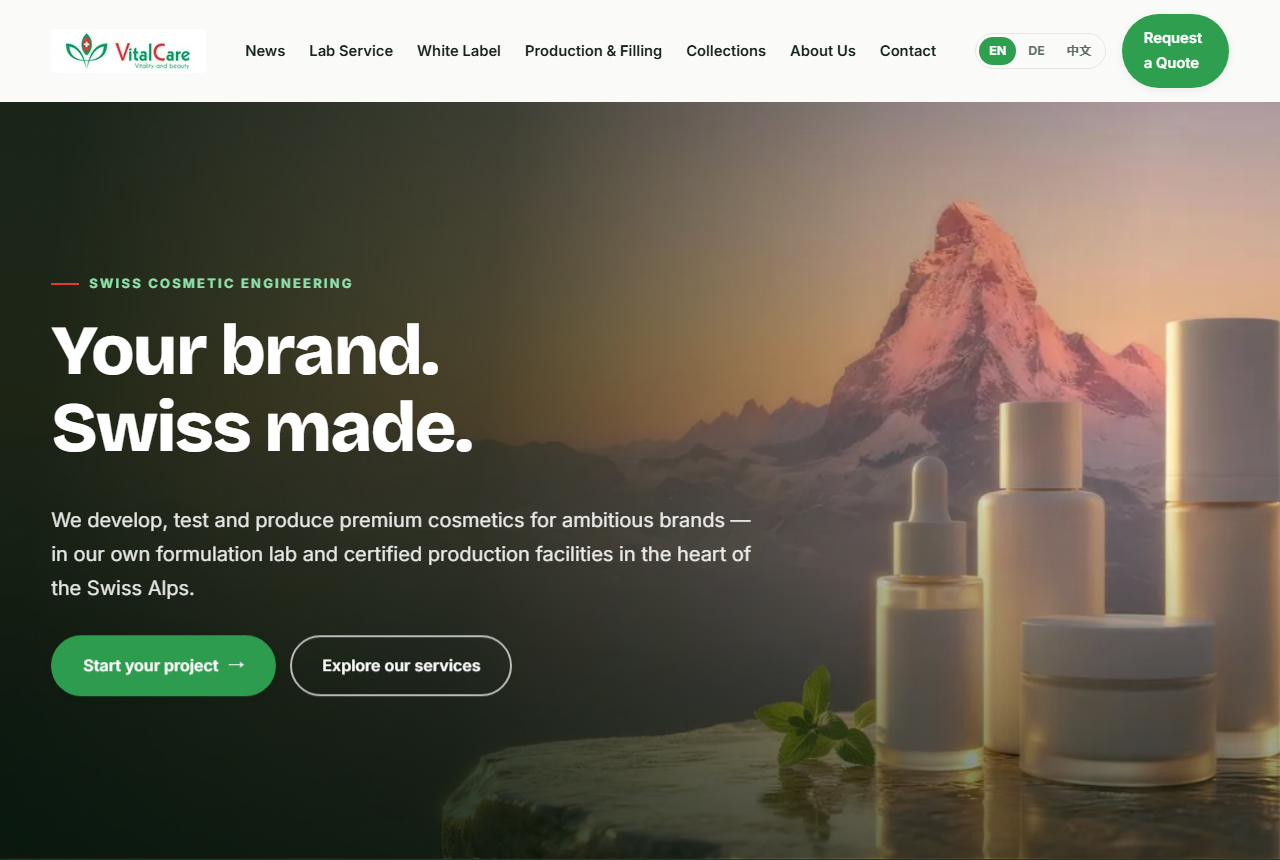
HQ: Heimberg, Bern · Type: Formulation lab, white label and OEM/ODM · Best known for: Cosmeceuticals and licensable ready-made collections
Swiss VitalCare is the most certification-dense company here, stating ISO 22716 cGMP, SQS ISO 9001:2015, COSMOS Organic/BDIH and cruelty-free status, with batch capacity from 100 kg to 15,000 kg and twelve ready-to-launch collections available for licensing. For a Malaysian brand that wants a credible premium range on shelf quickly, licensing an existing collection avoids the eighteen-month development cycle. Check the 100 kg floor against your forecast: for a 50 ml cream that is a few thousand units per run.
Temmentec AG
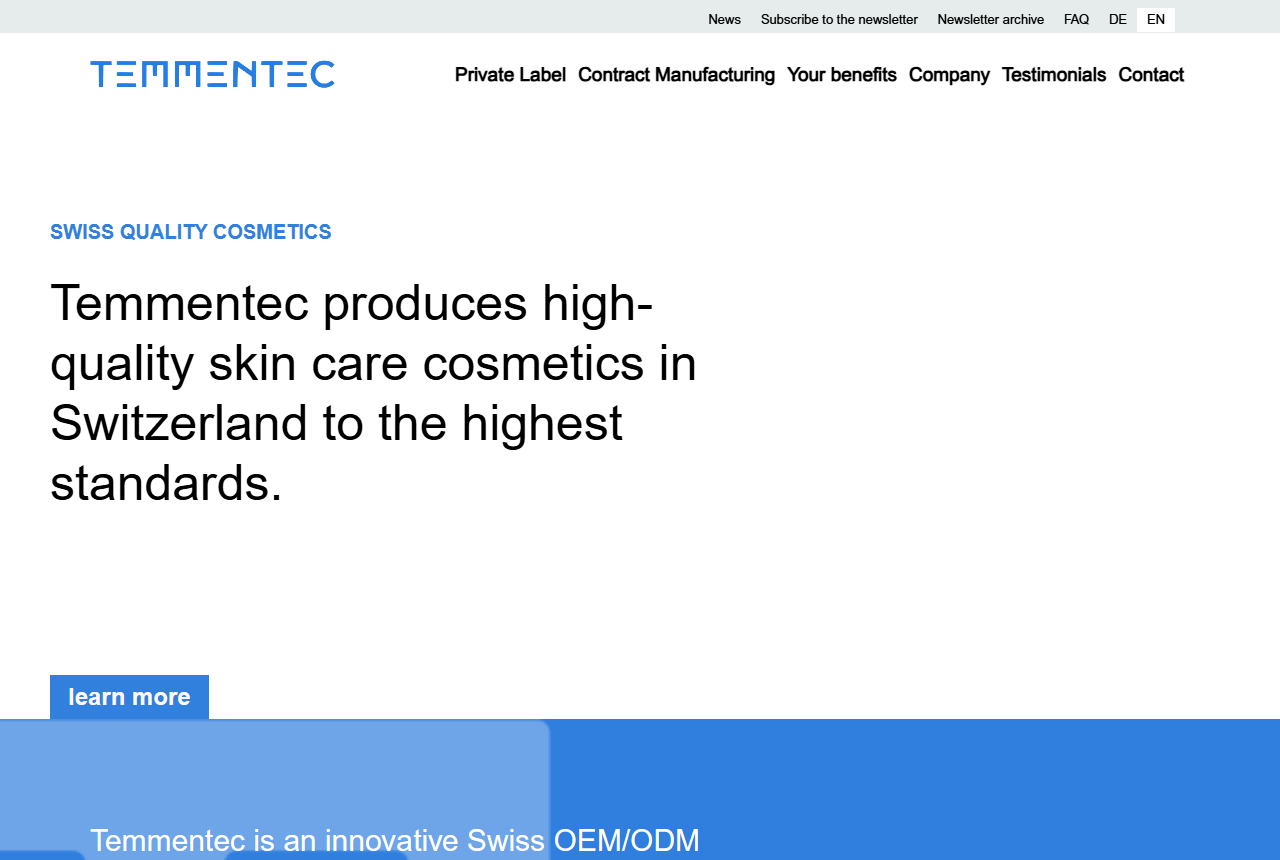
HQ: Sumiswald, Bern · Type: OEM/ODM contract manufacturer · Best known for: Skin care cosmetics on a site operating since 1916
Temmentec offers development, manufacturing, packaging, quality assurance and logistics either as a bundle or as individual steps — the second option being genuinely useful for a Malaysian brand that already owns a formula but has outgrown its current filler. It publishes an EcoVadis Bronze sustainability rating from 2023. Scope is the limit: this is a skincare house, so colour, fragrance and aerosol formats are not on the table.
Getting Swiss-made cosmetics into Malaysia: the NPRA reality
Wherever a product is manufactured, it cannot be sold, supplied or imported into Malaysia until it has been notified to the National Pharmaceutical Regulatory Agency through the Quest3+ system. A Swiss origin does not create a shortcut and does not exempt anything. What it does change is who assembles the file.
The notification holder must be a company incorporated in Malaysia — so either your own entity or a local agent takes that role and carries the responsibility that comes with it. Your Swiss manufacturer supplies the inputs: the full ingredient list with INCI names and percentages where required, a letter of authorisation, and manufacturing and quality documentation. In practice the friction points are consistent. First, ingredient annexes differ: Malaysia follows the ASEAN Cosmetic Directive, Switzerland mirrors the EU lists, and while the two overlap heavily they are not identical, so a formula perfectly legal in Bern can contain something restricted here. Ask your supplier to screen the formulation against the ASEAN annexes before development, not after. Second, claims: a European marketing claim that reads as therapeutic under Malaysian rules will force a reformulation of the packaging, or push the product out of the cosmetic category altogether.
Budget realistically for this stage. It is not difficult work, but it is sequential, and each round trip to a European supplier for a missing document costs a week. Our cosmetics and personal care guides cover the notification process in more depth.
The halal question, which is not a small one
For a large share of the Malaysian market, halal status is not a bonus feature. It determines shelf placement in some retailers and it determines whether a meaningful segment of consumers will consider the product at all.
Switzerland is a difficult origin here. Halal cosmetics certification infrastructure is thin on the ground, and the certificate you need is not just any halal certificate — under Malaysian rules the halal logo may only be used on a notified cosmetic product certified by JAKIM or by a foreign Islamic body that JAKIM recognises. A certificate from an unrecognised European certifier will not qualify your product for the Malaysian halal logo, however sincerely it was issued.
You have three options, none costless. Skip halal and position purely on premium and origin, which works in some channels and not others. Pursue Malaysian halal certification with a Malaysian representative company handling the application, accepting the audit burden falls on a factory eight thousand kilometres away that has probably never hosted one. Or manufacture regionally instead. For a mass-market or Muslim-consumer-focused product, the third option usually wins on commercial grounds alone.
Lead time, MOQ and landed cost: the honest arithmetic
Three numbers decide whether Swiss sourcing survives contact with a spreadsheet.
Lead time. Development typically runs several months before a first production batch, then sea freight from northern European ports to Port Klang adds roughly four to six weeks door to door, plus customs clearance. Air freight compresses that dramatically but is rarely viable for the weight of filled cosmetics. Add it up and a reorder placed today may not be on your shelf for three months, which means carrying more stock than a local supply chain requires — working capital that has to be priced into the model.
Minimum order quantity. The headline figure is almost never the binding one. Bulk may be flexible while decorated bottles, printed cartons and custom closures carry their own minimums in the thousands. Ask for a minimum on every line of the bill of materials.
Landed cost. The quoted unit price is the start. Add freight, insurance, import duty and SST, local warehousing, the notification and regulatory work, and the cost of holding three months of stock. A Swiss cream quoted at what looks like a manageable ex-works price can land at close to double that once everything is counted — which is survivable at RM250 retail and fatal at RM60.
When manufacturing in Malaysia makes more sense
Being straight about this is more useful than selling anyone a European dream. Local or regional manufacturing is the better call when any of the following is true.
You need halal certification for the mainstream Malaysian market. You are launching a first product and cannot fund a long development cycle plus three months of inventory. You expect to iterate the formula or packaging within the first year, where a factory two hours away beats one two flights away. Your retail price sits below roughly RM150, where imported landed cost eats the margin. Or you are selling into categories where Malaysian and ASEAN manufacturers are already strong — body care, cleansers, hair care, sun care built for tropical conditions.
Malaysian factories operating to ASEAN Cosmetic GMP and ISO 22716 produce for regional and export markets every day, and the good ones will sit down with you on notification, halal and packaging in the same meeting. If you want to compare on the same terms, our guide to sourcing from the Netherlands as a Malaysian brand covers a European base with more competitive economics, and the Turkish supplier landscape sits between the two on price.
A practical shortlisting sequence
If you are going ahead, run it in this order rather than starting with quotes. Define the product and the retail price first, then work backwards to the maximum landed cost you can carry. Approach three of the ten above whose scope matches your format. Ask each the same five questions: current GMP certificate and scope, whether your plan qualifies for the Swiss Made claim, minimum order quantity per bill-of-materials line, who owns the formula and the technical dossier, and whether they will screen the formulation against the ASEAN Cosmetic Directive annexes. Only then request pricing. The answers to those five questions will eliminate at least one candidate before money is discussed.
Frequently asked questions
Do I need NPRA approval to import cosmetics made in Switzerland?
You need notification, not approval. Every cosmetic product sold, supplied or imported into Malaysia must be notified to the NPRA through the Quest3+ system before it goes to market, regardless of country of manufacture. The notification holder must be a locally incorporated company — your own entity or an appointed agent. A Swiss GMP certificate does not replace or shorten this process, though good manufacturing documentation makes assembling the file faster. Requirements change, so verify the current process with the NPRA before you commit to a shipment.
Can a Swiss-made cosmetic be certified halal for the Malaysian market?
It can in principle, but it is difficult in practice. Under Malaysian rules the halal logo may only be used on a notified cosmetic product certified by JAKIM or by a foreign Islamic certification body that JAKIM recognises. Switzerland has limited halal cosmetics certification infrastructure, and a certificate from an unrecognised body will not qualify. The workable route is applying for Malaysian halal certification through a Malaysian representative company, which means a Swiss factory hosting an audit process it is unlikely to have experienced. For halal-critical products, regional manufacturing is usually the more realistic path. The notable exception outside Asia is South Africa, which has three JAKIM-recognised certifiers; our guide to South African cosmetic factories for Malaysian brands covers what that recognition does and does not allow.
How long does it take to get product from a Swiss factory to Malaysian shelves?
Plan on the better part of a year for a first launch. Formulation development and sampling typically take several months, pilot and stability work adds more, production scheduling depends on the factory’s book, and sea freight from northern Europe to Port Klang runs roughly four to six weeks before customs clearance and local distribution. NPRA notification runs alongside but needs the manufacturer’s documents in hand. Repeat orders are faster, but the freight leg means you should hold noticeably more safety stock than with a local supplier.
Is Swiss manufacturing worth the premium for a Malaysian brand?
It depends almost entirely on your retail price and your channel. Above roughly RM150 a unit, in premium skincare, cosmeceuticals or clinic channels where origin is part of the proposition, the numbers can work — particularly if you qualify for the legally protected Swiss Made claim and can charge for it. Below that, imported landed cost, longer lead times and the halal gap usually make a Malaysian or regional factory the stronger commercial choice. Model the full landed cost, not the quoted unit price, before deciding.
This article is general information for brand owners and is not regulatory or legal advice. Company details are as published by each manufacturer and were checked on 4 September 2026; certifications and capabilities change. Verify current notification, labelling and halal requirements with the NPRA, JAKIM and your own regulatory consultant before importing or selling.
About the author
Daniel Yeoh writes on OEM sourcing and supply chain for MalaysiaOEM, with a focus on how import logistics and regulation shape what a brand can realistically manufacture abroad.