By Aisyah Karim · Halal Cosmetics & Market Entry Advisor · Published 31 Jul 2026
Malaysian beauty brands have spent the last five years looking east for contract manufacturing — Korea for formulation trends, China for price, Thailand for speed. Turkey barely enters the conversation, and that is starting to look like an oversight. Turkish cosmetic suppliers sit inside a customs union with the European Union, run plants certified to European good manufacturing practice, and produce fragrance, aerosol and dermocosmetic formats at volumes very few Southeast Asian factories can match. For a Malaysian brand owner planning a deodorant range, a perfume line or a dermocosmetic serum, that is a shortlist worth understanding before you commit.
This guide profiles ten real Turkish cosmetic suppliers whose official websites we opened and captured in July 2026, then works through the part that actually decides whether the deal makes sense from Kuala Lumpur: NPRA product notification, Halal certification, freight and lead time, MOQ economics, and the honest cases where a Malaysian OEM is simply the better answer.
Key takeaways
- Turkey’s cosmetic sector is regulated under a framework harmonised with EU Regulation (EC) No 1223/2009, so the safety documentation you receive is already in a form Malaysian regulatory consultants recognise.
- Published minimum order quantities at the smaller Turkish houses start around 1,000–2,000 units per SKU, which is realistic for a Malaysian brand testing a range.
- Sea freight from Istanbul or Izmir to Port Klang typically runs longer than a Guangdong or Bangkok sailing, so plan a wider buffer between purchase order and shelf date.
- Every product still needs its own NPRA notification through Quest3+ with a Malaysian-registered holder — a Turkish certificate of free sale does not substitute for it.
- Halal is a genuine Turkish strength, but a Turkish halal certificate is only useful in Malaysia if the certifying body is recognised by JAKIM. Confirm that before you build packaging around a halal logo.
Why Turkey is worth a look for Malaysian brand owners
Turkey occupies an unusual position in global cosmetics manufacturing. It produces at a cost base well below western Europe while operating inside the EU customs union, which means Turkish factories have spent two decades building quality systems to European expectations because European retailers are their largest customers. A Malaysian brand buying from that supply base inherits documentation habits, batch record discipline and stability-testing practice that were developed for a demanding market, without paying western European prices.
The second reason is format depth. Turkey is one of the world’s serious producers of fragrance and aerosol cosmetics — body sprays, deodorants, hair sprays, room and car fragrance — and those are precisely the categories where Southeast Asian capacity thins out. If your product concept involves a pressurised can, a fine-fragrance juice or an alcohol-based cologne, the number of local factories that can genuinely produce it is small, while in Turkey it is a mainstream capability with plants running hundreds of thousands of units a day.
How this shortlist was built
Ten companies made the list. Each one had to physically manufacture in Turkey, publicly offer contract manufacturing, private label or ODM services, maintain a live official website that we could open and capture, and name cosmetics as a real product line rather than a sideline to detergents or supplements. Companies whose websites were parked, blocked, broken or covered by consent pop-ups were left out, as were foreign laboratories running Turkey-targeted landing pages. The companies appear in alphabetical order; the numbers are labels and not a ranking, and no company paid for a place here.
What we did not do matters just as much. We did not audit any plant, inspect any certificate, ask for a quotation or contact any company. Certifications, capacities and minimum order quantities below are reported as each manufacturer publishes them, and should be verified in writing before you send a deposit.
The ten Turkish cosmetic suppliers
1. Asil Global
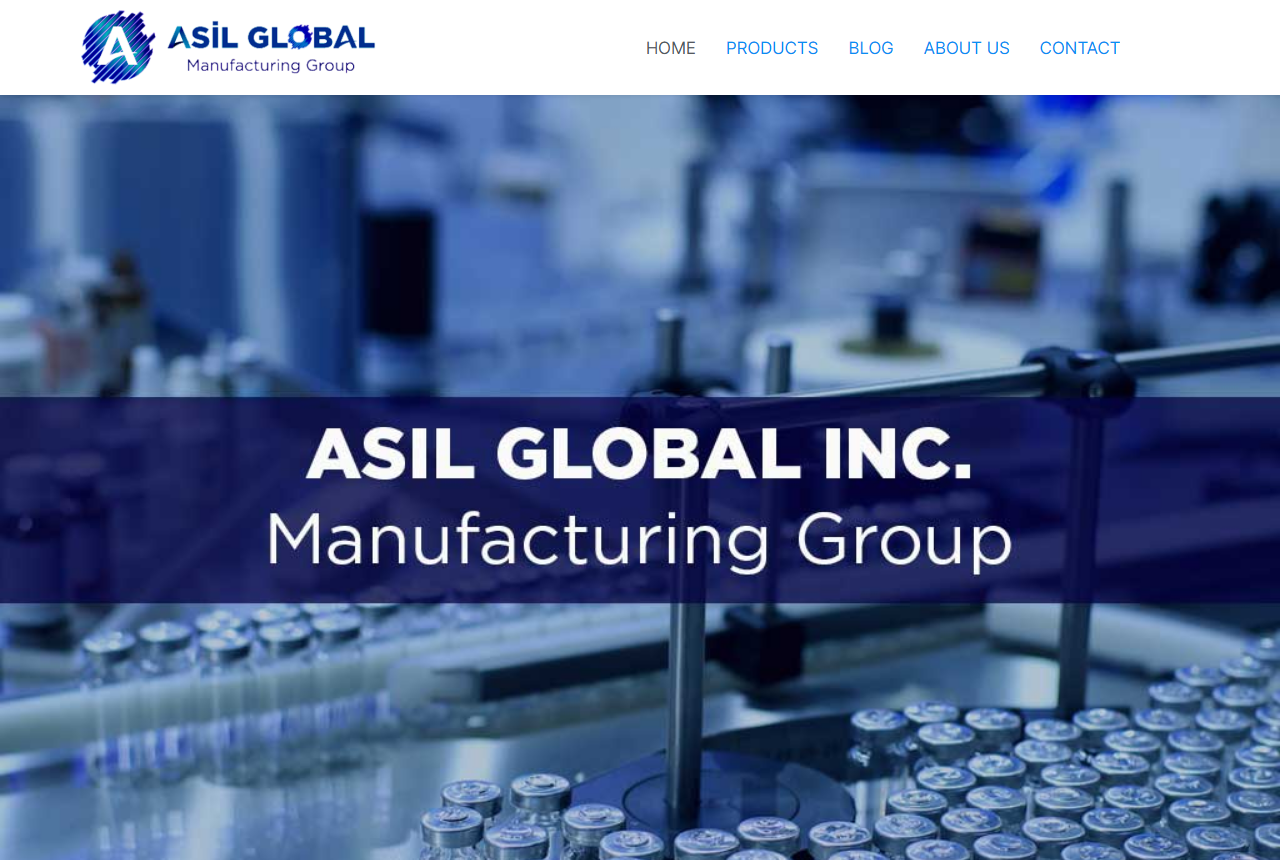
HQ: Istanbul · Type: Manufacturing group with contract filling · Best known for: Aerosols, fragrance and personal-care filling
Asil Global runs its own Biomate and Noxy Herbal labels alongside contract work for distributors, and the published range points clearly at filling capability: deodorants and body sprays, perfumes, shower gels, shampoos and depilatory creams. Export markets named on the site include the UK, France, the Netherlands, Germany and the Gulf. There is no published plant size, certificate list or minimum order quantity, so a Malaysian buyer should treat the first email as a document request rather than a price enquiry.
2. Dağlar Kozmetik
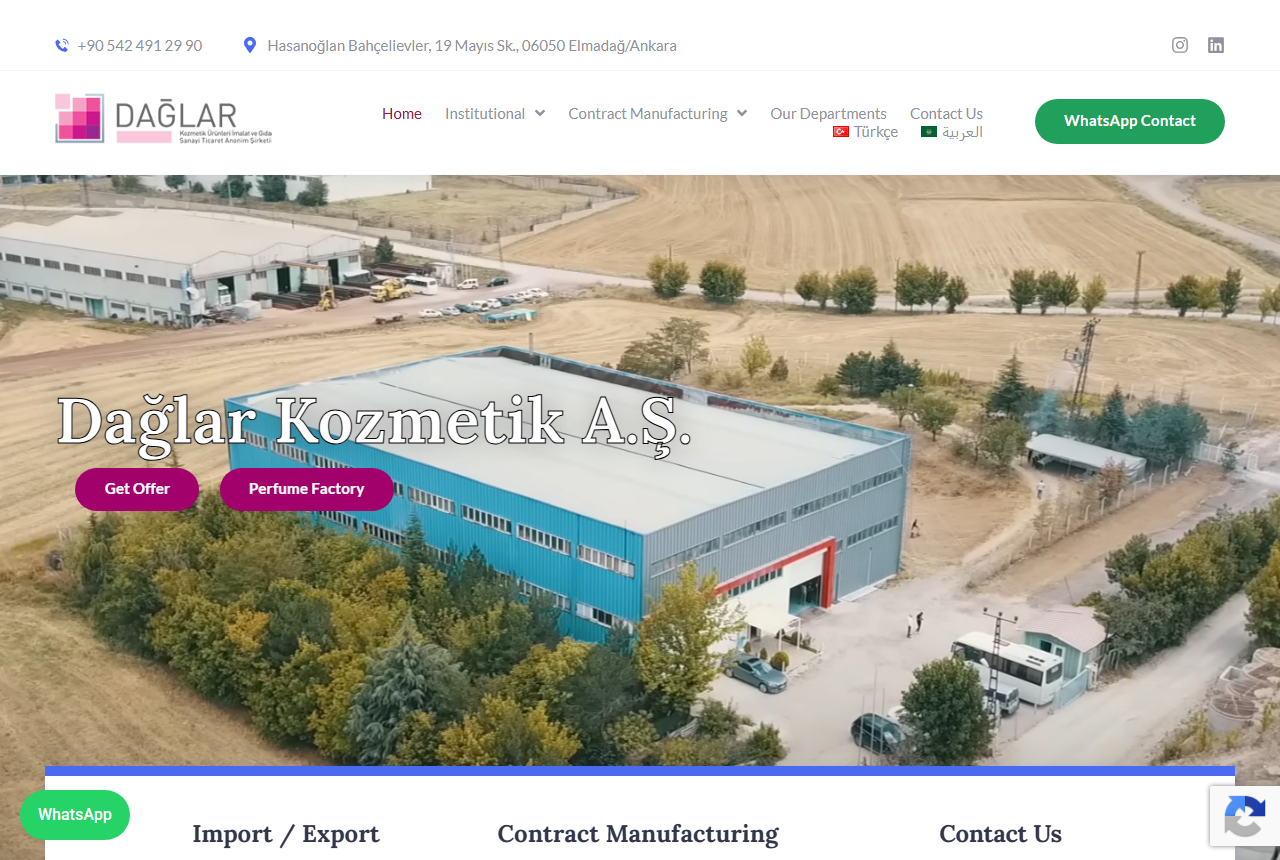
HQ: Elmadağ, Ankara · Type: Contract manufacturer · Best known for: Perfume production at scale
Trading since 1997 from a 14,000 square metre plant outside Ankara, Dağlar states it has produced for over 1,400 brands across a dozen categories, with fragrance as the headline specialism and a dedicated perfume-factory route on its own website. It also handles import and export logistics, which can simplify a first shipment. The location is the practical consideration for a Malaysian buyer: Ankara is inland, so goods travel overland before they reach a container port, and that leg belongs in your lead-time calculation.
3. ÉLAN KIMYA
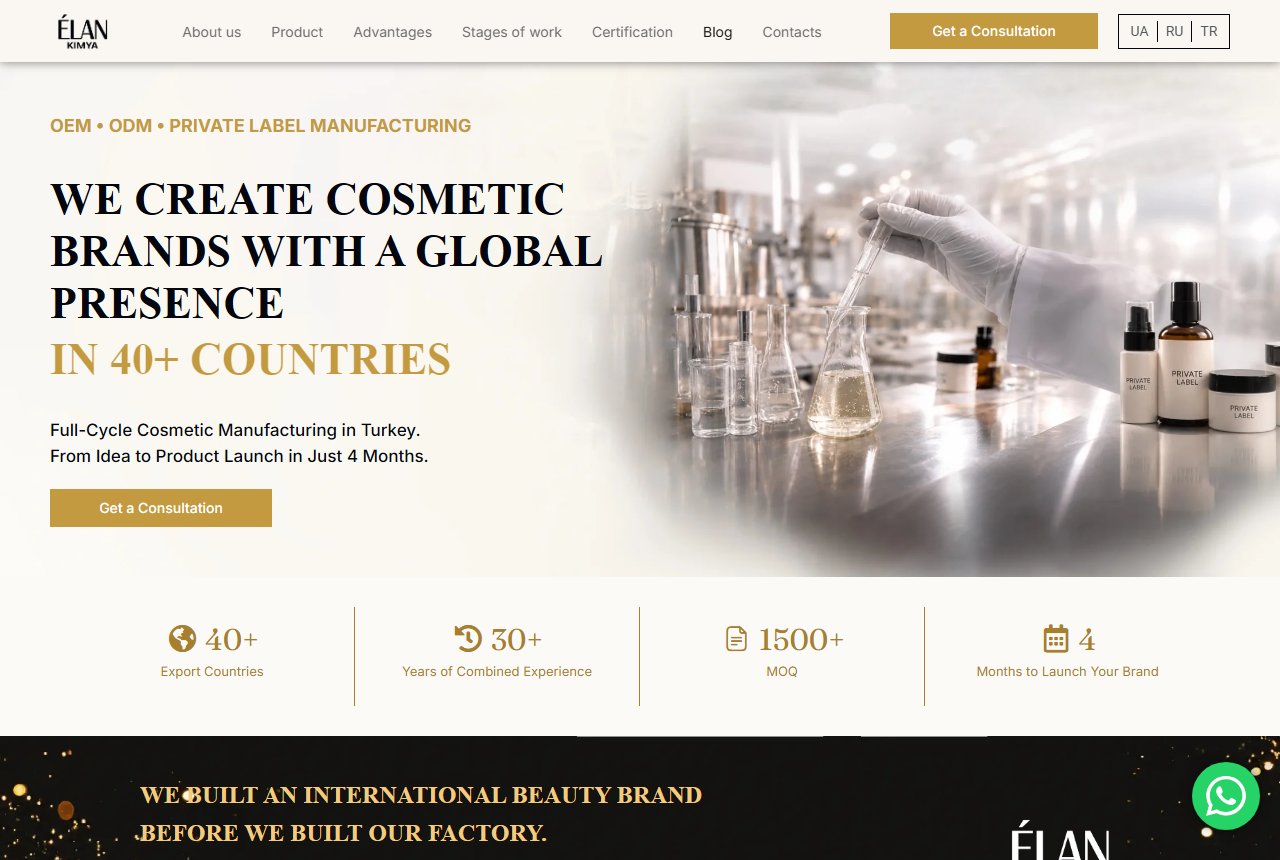
HQ: Antalya · Type: OEM, ODM and private label · Best known for: Published timelines and minimums
Established in 2022, Élan Kimya is the newest company here and also the most forthcoming: roughly 1,500 to 2,000 units per SKU as a minimum, exports to more than 40 countries, production aligned to GMP and ISO 9001:2015, and a stated four-month path from concept to launch with one to two weeks for sampling. The catalogue covers skincare, hair care, colour cosmetics and brow and lash products. Balance that transparency against a trading history measured in years rather than decades, and ask for references from clients in comparable markets.
4. Elya Kozmetik
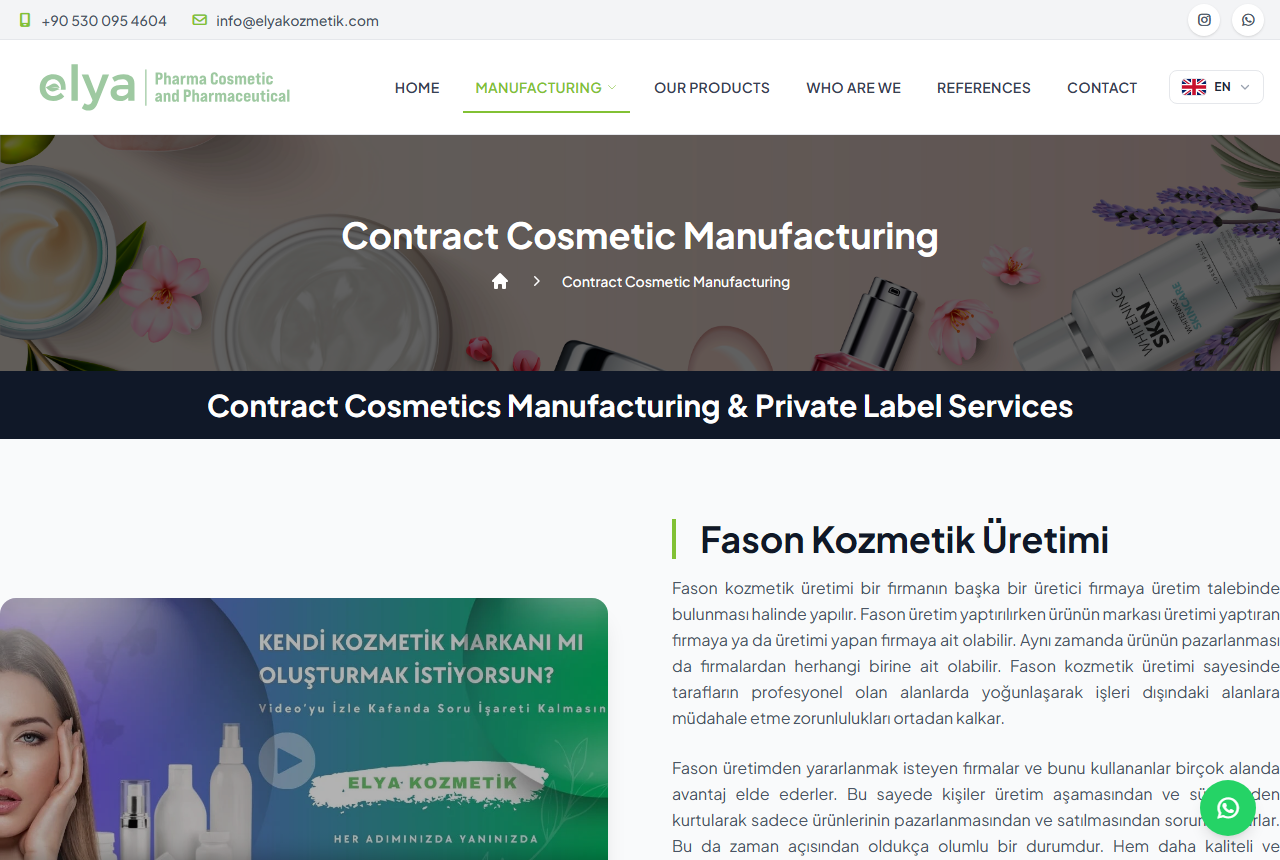
HQ: Habibler, Istanbul · Type: Contract cosmetics and supplements · Best known for: Mid-size skincare and hair-care runs
Elya produces creams, serums, sunscreens, shampoos, BB creams, tonics, peelings, clay masks and keratin treatments, with food supplements made on the same site — useful if your roadmap includes an ingestible beauty product later. Facilities are described as GMP certified and minimums are quoted flexibly, typically between 1,000 and 5,000 units. Much of the deeper site content is in Turkish, so expect an early exchange about working language and whether technical documents will be issued in English.
5. Erte Cosmetics
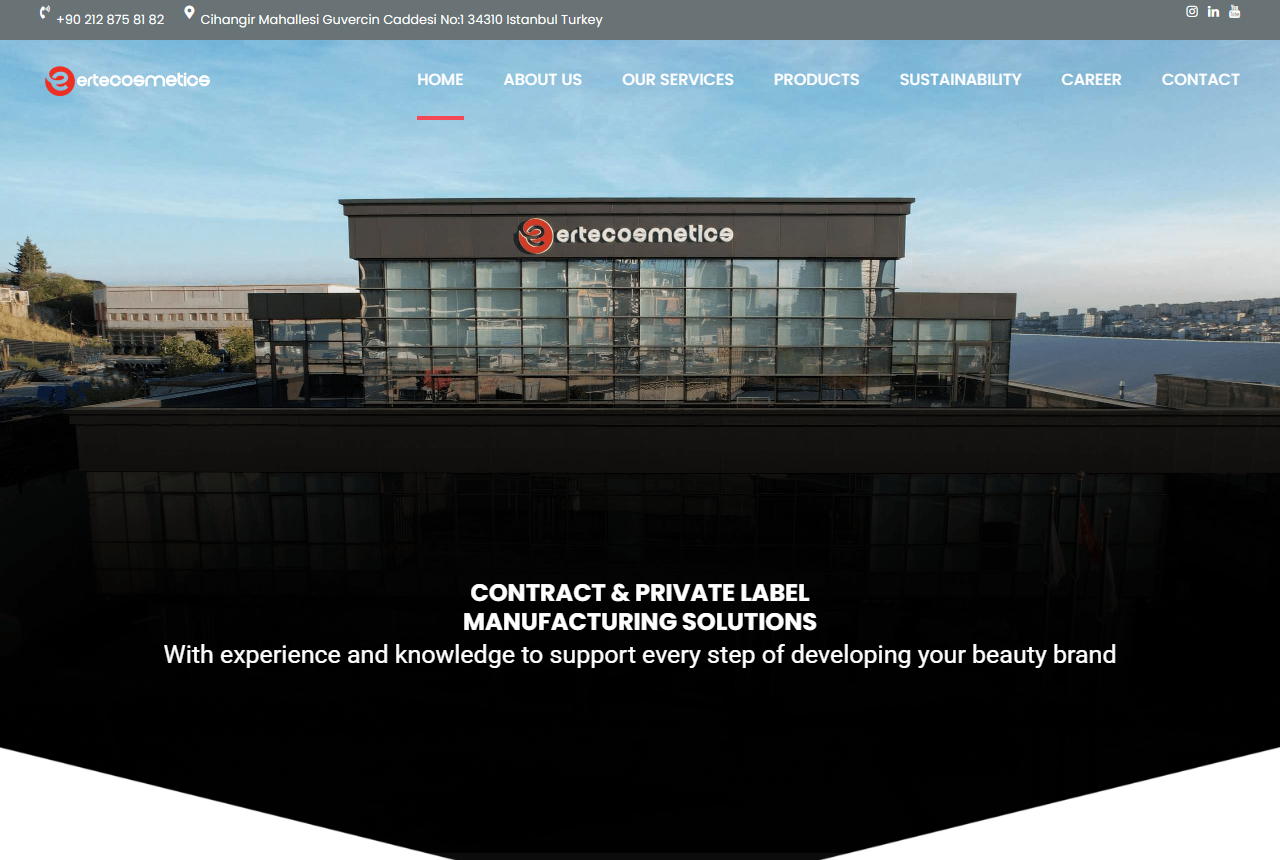
HQ: Avcılar, Istanbul · Type: Large-scale contract manufacturer · Best known for: High-volume fragrance, bath and body
Part of the Erkul Group and trading since 2003, Erte is the biggest dedicated contract operation on this list: a stated 40,000 square metre production area, around 310 staff, capacity above 100 million units a year and exports to more than 65 countries across perfume, home fragrance, bath and body, skincare and hair care. That scale is an asset if you are supplying a Malaysian retail chain with repeat volume, and a mismatch if you are ordering a single trial batch of one thousand bottles.
6. Gelişim Kozmetik
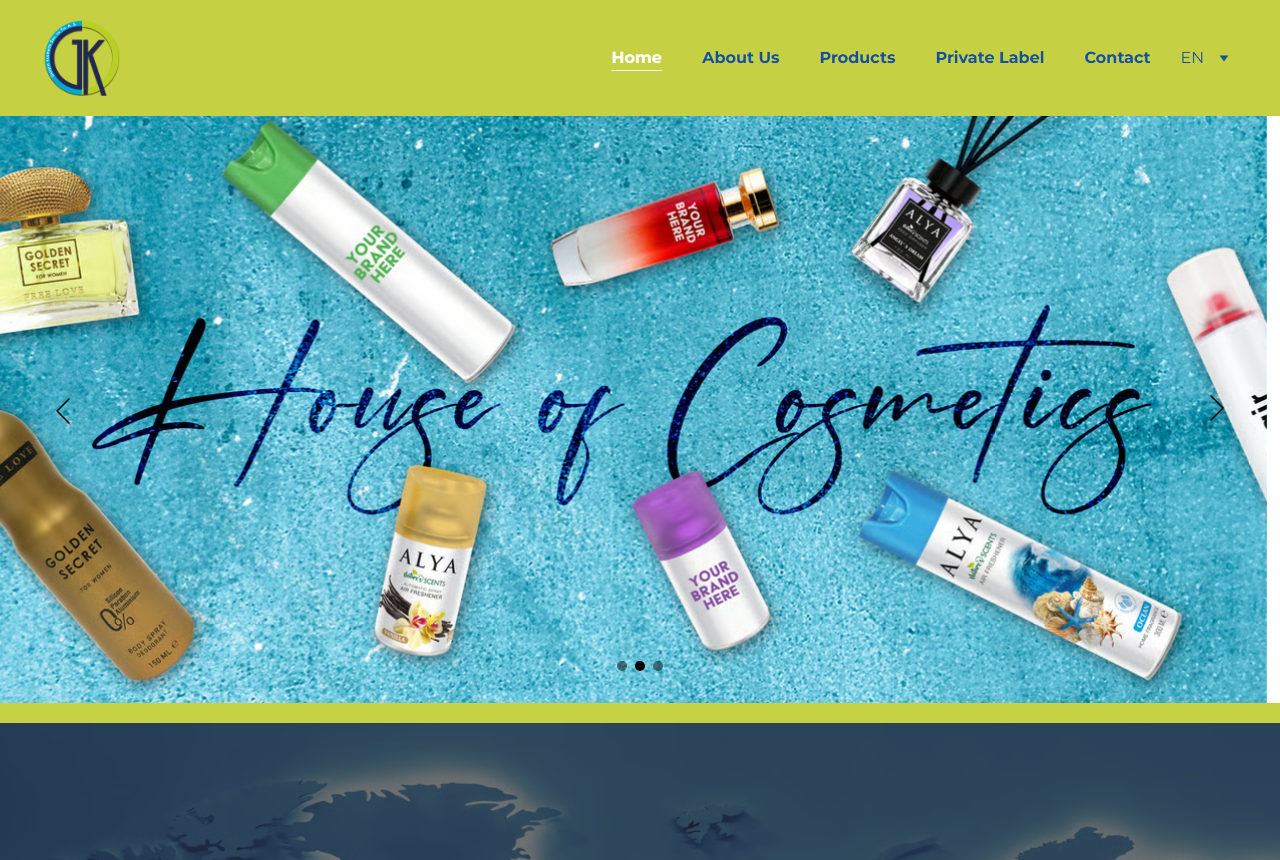
HQ: Istanbul · Type: Aerosol and fragrance manufacturer · Best known for: Deodorants, body sprays, room fragrance
Gelişim has been trading for over 30 years from a 12,000 square metre plant, quoting daily capacity of roughly 360,000 aerosol units and about 75,000 perfume or liquid units, with exports to more than 50 countries under its own ALYA, CHEETAH and PROVA brands as well as for private-label clients. It cites ISO 9001:2015 and GMP compliance. For a Malaysian brand building a body-spray or air-care line this is real depth; for a treatment serum it is the wrong specialism entirely.
7. Hunca Kozmetik
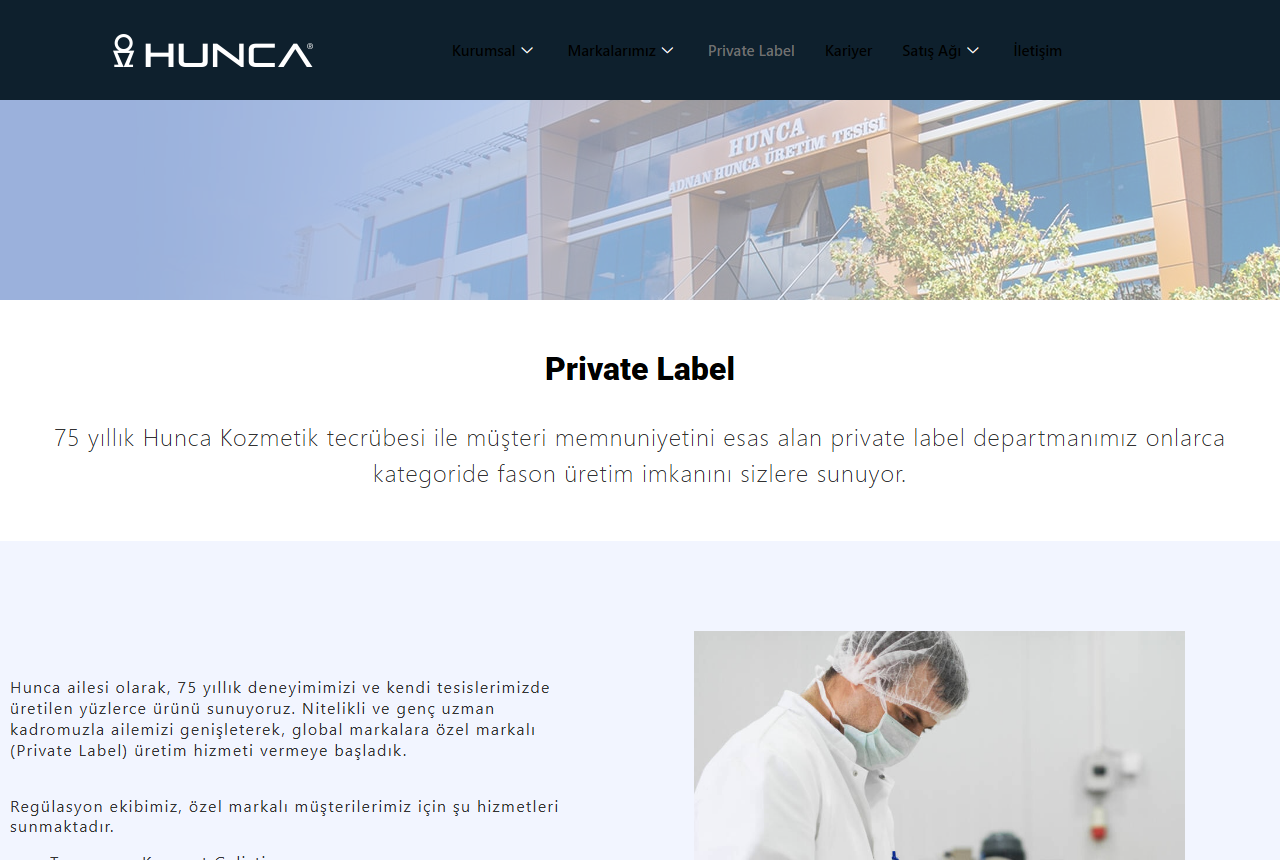
HQ: Istanbul; plant at Çerkezköy, Tekirdağ · Type: Own-brand house with a private-label department · Best known for: Deodorant, fragrance and personal care
Founded by Adnan Hunca and now in its eighth decade, Hunca produces from a 22,000 square metre plant with more than 500 employees and exports to over 60 countries. Private label is a named department with its own regulatory team rather than a side offer. The structural caveat is that the group’s own brands are the commercial priority, so a Malaysian client should ask directly how contract orders are scheduled against internal production, particularly around peak retail seasons.
8. International Group Nacar (IGN)
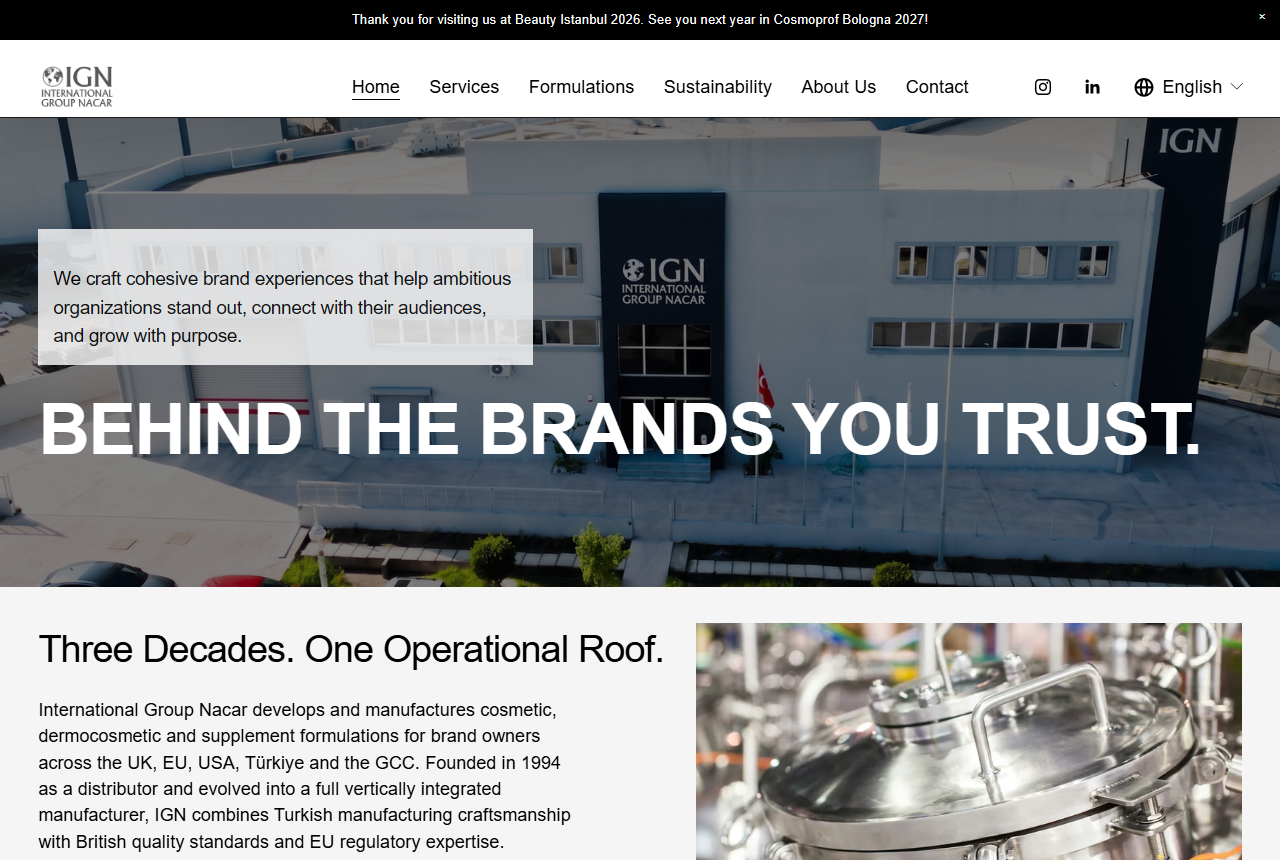
HQ: İzmir · Type: Vertically integrated dermocosmetics manufacturer · Best known for: Dermocosmetics and suncare
Operating since 1994, IGN runs two GMP-certified factories in İzmir with additional offices in London and Tallinn, which places European and British regulatory capability inside the same group as the plant. The catalogue spans skincare, suncare, dermocosmetics, colour, men’s and professional ranges plus supplements, with stated capability from low-MOQ runs up to commercial batches. If your Malaysian brand also has ambitions in the Gulf or Europe, a manufacturer already fluent in those dossiers saves a consultant’s fee later.
9. MKN Group
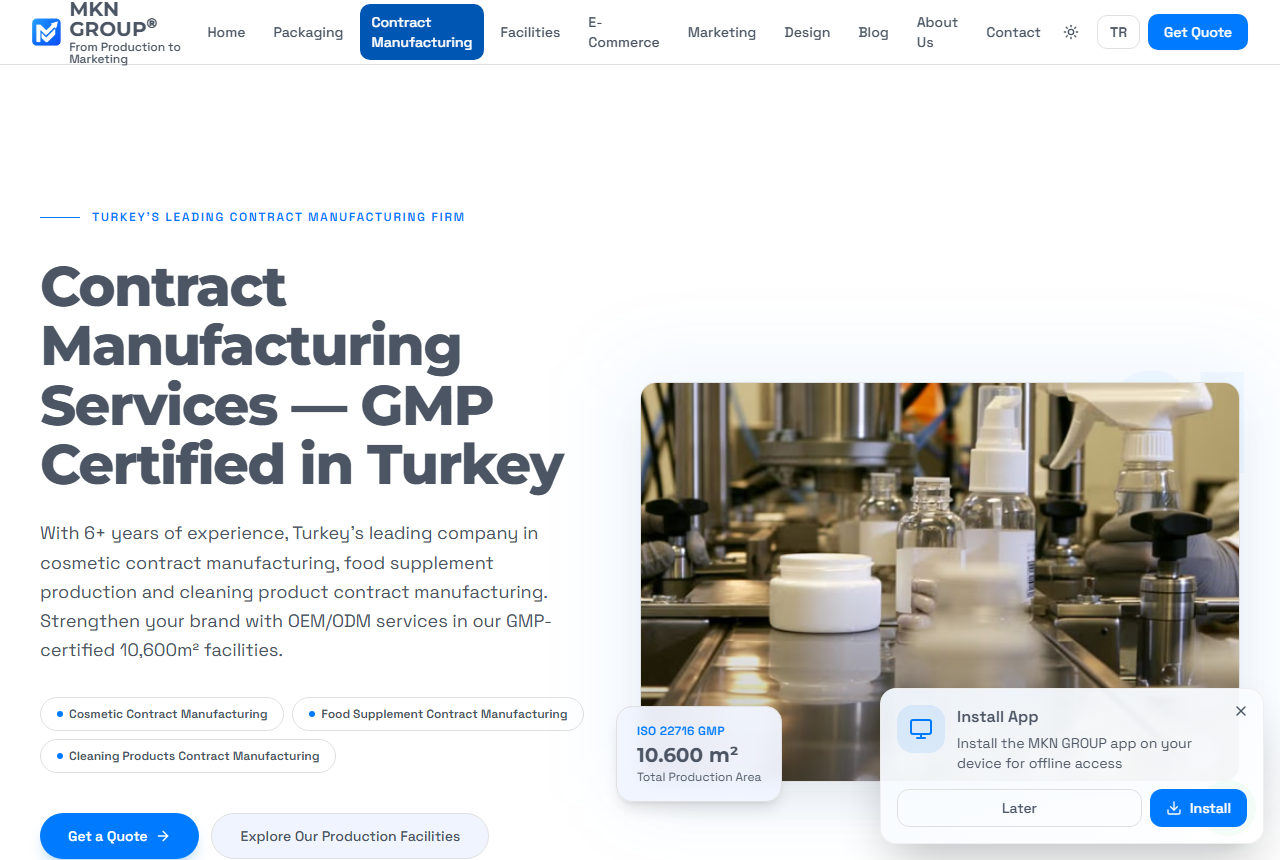
HQ: Istanbul · Type: Contract manufacturer plus packaging and e-commerce services · Best known for: A published 1,000-unit minimum
MKN publishes the numbers most buyers have to prise out of a sales team: ISO 22716 cosmetic GMP certification, 10,600 square metres of production area, a 1,000-unit minimum order and a seven-day sample turnaround across cosmetics, supplements and cleaning products. It also sells packaging, design and marketing services, which is convenient for a small brand and redundant for one with its own creative team. Note the company describes itself as having six-plus years of experience, so verify the published figures rather than assuming them.
10. Turunch Cosmetics
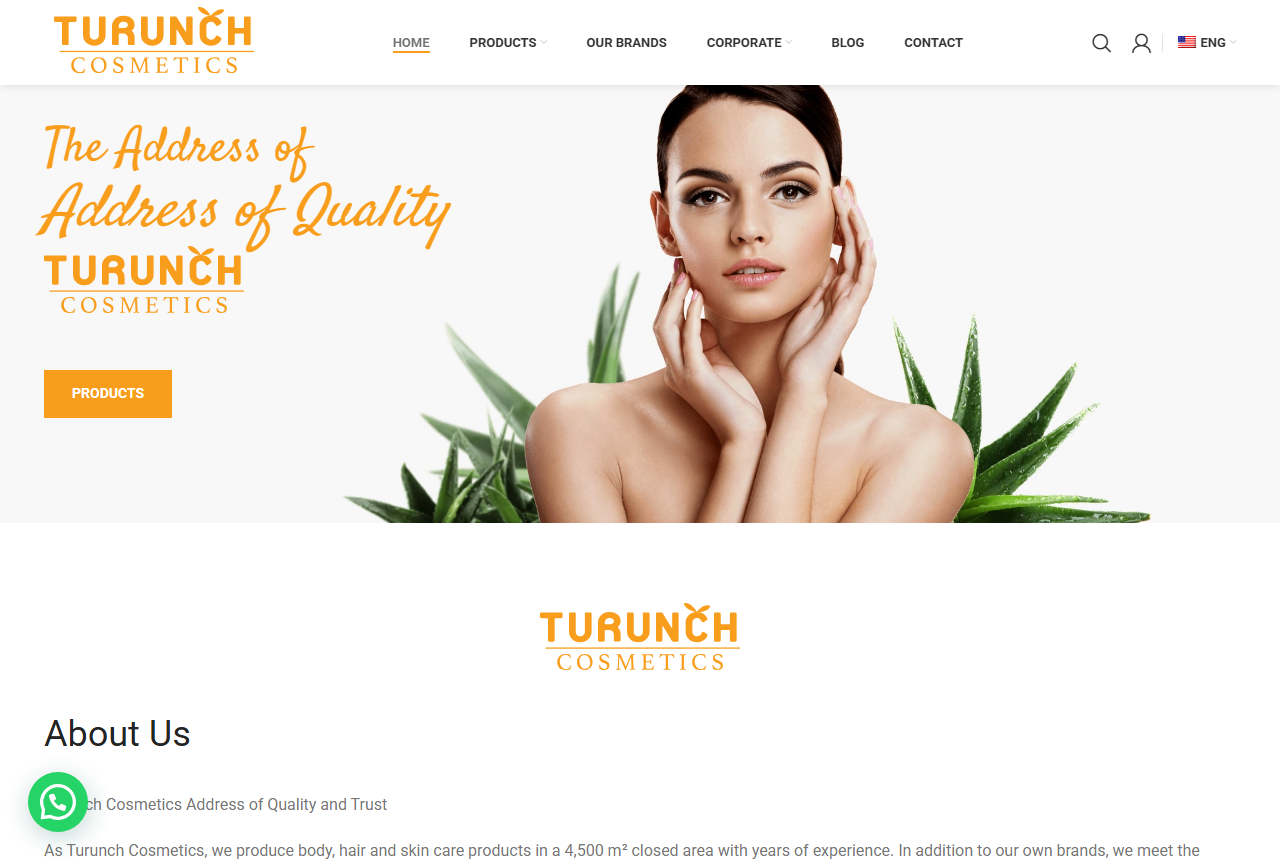
HQ: Kağıthane, Istanbul · Type: Manufacturer-brand with private-label service · Best known for: Small-batch skin, body and hair care
Turunch produces skin, body and hair care from a 4,500 square metre facility, running its own brands alongside private-label work. It publishes a management-system certificate set covering ISO 9001:2015, ISO 14001, ISO 45001 and ISO 10002, and references GMP practice in its contract material, although the cosmetic GMP certificate itself is not documented publicly. At this footprint it suits a brand testing a first range rather than one forecasting pallets per month.
Bringing Turkish-made cosmetics into Malaysia: the NPRA reality
Manufacturing abroad changes nothing about your Malaysian obligations. Every cosmetic product sold in Malaysia must be notified to the National Pharmaceutical Regulatory Agency through the Quest3+ system before it goes on sale, and the notification must be held by a company incorporated in Malaysia. That holder carries the legal responsibility for the product: the ingredient listing against the ASEAN Cosmetic Directive annexes, the label claims, the adverse-event reporting duty and the obligation to produce a Product Information File on request.
Practically, this means you need three things from a Turkish supplier before you notify. First, a full quantitative or at minimum qualitative formula in INCI order, because Quest3+ will not accept a vague ingredient statement. Second, a manufacturer’s declaration or certificate of free sale confirming the product is legally manufactured in Turkey. Third, the supporting safety and stability data that sits behind the Product Information File, which the NPRA can request at any point after notification. A European-oriented Turkish factory will usually have all three because the EU regime demands the same evidence, but get them in English and get them before you place the order, not after the goods land.
Halal certification: a genuine Turkish strength with one catch
Turkey has a substantial domestic halal certification infrastructure and many Turkish manufacturers hold halal certificates as a matter of course, which is unusual among European-facing suppliers. For a Malaysian brand, that sounds like a shortcut. The catch is recognition: a halal claim on a product sold in Malaysia carries weight only if the certifying body is among those recognised by JAKIM, and not every foreign certificate qualifies. Before you commit to halal-led packaging or marketing, ask your Turkish supplier which body issued the certificate, confirm its recognition status, and plan for the possibility that a fresh certification route is needed. Where halal is central to your positioning rather than a bonus, sourcing from an already-certified Malaysian plant removes the question entirely.
Lead time, freight and the real cost of distance
The quoted unit price is the smallest part of this decision. Sea freight from Istanbul or Izmir to Port Klang is a longer sailing than the routes Malaysian brands are used to from Guangdong, Bangkok or Ho Chi Minh City, and it usually involves a transhipment. Add production time, pre-shipment inspection and documentation, and a realistic order-to-shelf window for a first Turkish production run is materially longer than a regional one. Build that into your launch calendar and your cash-flow plan rather than discovering it during a stock-out.
Airfreight exists as a rescue option but rarely survives contact with the maths on liquid cosmetics, where volumetric weight is punishing. Aerosols compound the problem: pressurised containers are classified as dangerous goods, which restricts carriers, adds documentation and raises cost on both air and sea. If deodorant or body spray is your product, ask about dangerous-goods handling in your very first conversation, not at booking.
MOQ economics: what a 1,000-unit minimum really means
A published minimum order quantity describes what the factory will fill. It does not describe what you can actually buy. Custom packaging — a bespoke bottle, a specific pump, a printed carton, a decorated cap — routinely carries its own minimum in the several-thousand range from the component supplier, and that number, not the factory’s, usually sets the size of your first order. Ask any Turkish supplier for the minimum expressed in filled units of your chosen pack, with the component minimums broken out separately.
Then apply distance. Ordering 1,000 units from a factory eight hours’ drive away is a low-risk experiment; ordering 1,000 units that arrive by sea after a long transit, with a duty and freight bill attached, is a different proposition. Small trial orders make more economic sense close to home. Turkey earns its place when the volume justifies the journey, or when the format simply cannot be produced regionally.
Quality assurance from 8,000 kilometres away
You will not be walking the line. That makes contractual and documentary controls the substitute for presence. Agree written specifications for the bulk and the finished unit, define the acceptance criteria for colour, odour, viscosity and pH, and specify what happens when a batch falls outside them — rework, replacement or credit. Require retained samples for every batch and a certificate of analysis with each shipment.
Third-party pre-shipment inspection is worth its fee on a first order. An independent inspector at the Turkish plant checking fill volumes, label accuracy, carton counts and packing condition costs a fraction of a rejected container. Insist on approving a production-condition sample — made on the actual line, in the actual pack — rather than a laboratory bench sample, because the two are not the same product.
When a Malaysian OEM is the better answer
Turkish sourcing is not automatically the smarter move, and it is worth being blunt about when local manufacturing wins. If your product is halal-led and you need a JAKIM-recognised certificate without complications, a Malaysian plant is simpler. If you are launching a first range of two or three SKUs at a few thousand units each, local minimums and short freight will beat any Turkish unit-price advantage on landed cost. If your product needs frequent reformulation — a fast-moving trend line where the shade or texture changes each season — being able to visit the lab and approve a sample the same week is worth more than any per-unit saving.
Local also wins on regulatory proximity. A Malaysian contract manufacturer prepares NPRA dossiers routinely, knows what Quest3+ will reject, and can respond to an NPRA query in days. Many Malaysian brands end up running a split strategy: core skincare and halal-positioned lines produced domestically, with specialist formats such as fragrance or aerosols sourced from a country like Turkey where that capability is deep. You can browse our other cosmetics and personal care OEM guides to compare local options against overseas ones.
How to run a first enquiry with a Turkish supplier
Send one brief to every shortlisted supplier, identical in every respect, so the replies are comparable. Include the product type, target texture and claims, pack format and size, target retail price, first-order quantity, forecast for twelve months, and the destination market with its regulatory regime named. Ask for five specific things: cosmetic GMP certificate scope and issuing body, minimum order quantity in filled units, sampling lead time and cost, production lead time from purchase-order approval, and payment terms.
Judge the replies on more than price. A supplier that returns a structured quotation with clear assumptions, asks intelligent questions about your claims, and volunteers its documentation limits is showing you how the relationship will run. One that answers a technical brief with a price list is showing you the same thing. If you want a comparison set for the decision, our guides to cosmetic factories in Poland and cosmetic factories in China cover the two markets Malaysian brands most often weigh Turkey against.
Frequently asked questions
Can I sell a Turkish-made cosmetic in Malaysia without changing the formula?
Usually yes, but not automatically. Turkish cosmetic rules are harmonised with the European regulation, and the ASEAN Cosmetic Directive that Malaysia applies shares most of its restricted and prohibited ingredient lists with the EU. Differences do exist, particularly around certain preservatives, colourants and UV filters. Have the full INCI formula screened against the current ASEAN annexes before production, not after, because a single non-compliant ingredient can invalidate an entire batch and there is no economical fix once it is filled.
Do Turkish suppliers handle the NPRA notification for me?
No. NPRA notification through Quest3+ must be submitted by a company incorporated in Malaysia, which will be you or an appointed local agent. What a competent Turkish supplier provides is the underlying evidence: the ingredient listing in INCI order, the manufacturer’s declaration or certificate of free sale, and the safety and stability data behind the Product Information File. Agree in your contract that this documentation is supplied in English and updated whenever the formula changes, otherwise a minor reformulation can quietly leave your notification unsupported.
Is Turkish manufacturing cheaper than Malaysian manufacturing?
Not reliably, once everything is counted. Turkish unit prices can be attractive at volume, but a Malaysian brand must add international freight, import duty and taxes, longer working capital tied up in transit, and the cost of managing a supplier in a distant time zone. On small first orders the landed cost usually favours a local plant. Turkey becomes competitive at genuine volume, or where the format — fine fragrance, aerosols, certain dermocosmetics — is difficult to produce locally at acceptable quality.
How long should I allow between placing an order and having stock in Malaysia?
Plan generously. A realistic sequence is sampling and approval, then production, then documentation and pre-shipment inspection, then sea freight from a Turkish port to Port Klang with likely transhipment, then customs clearance. Each stage has its own slippage, and a first order with a new supplier almost always runs longer than a repeat one. Treat any single quoted lead time as the best case, add a buffer of several weeks, and do not schedule a marketing launch against the earliest possible arrival date.
This article is general information for brand owners and is not regulatory or legal advice. Cosmetic notification requirements, ingredient restrictions and halal recognition lists change — verify current requirements with the NPRA, JAKIM and your own regulatory consultant before manufacturing or importing. Company details are drawn from each manufacturer’s published website material as at July 2026 and are not independently audited.
About the author
Aisyah Karim is a halal cosmetics and market entry advisor who works with Malaysian beauty brands on certification pathways, overseas sourcing and NPRA product notification.
Weighing more than one import market? Our companion guide to cosmetic factories in Canada for Malaysian brands covers a market with far lower minimum order quantities but much longer freight times.