By Arif Hakim · Regulatory & Compliance Specialist · Published 19 Jul 2026
Ingestible beauty has quietly become one of the harder sourcing briefs in Malaysia. A brand owner who already sells a serum assumes that adding a collagen drink is a small step — same buyer, same shelf, same marketing story. It is not. The moment a beauty product is swallowed rather than applied, it leaves the cosmetic notification regime and enters the health supplement registration regime, and the factory that makes your cream almost certainly cannot legally make your drink. Finding a genuine OEM nutricosmetic factory in Malaysia therefore means screening on regulatory scope and format capability first, and brand chemistry second.
This guide works through five Malaysian factories with real beauty-supplement capability — and names the well-known beauty manufacturers that did not qualify, which is arguably the more useful half. The ranking matters less than the decision framework around it. If you are launching a collagen sachet, a glutathione drink or a skin-health gummy, the questions below — about MOQ, sampling, MAL registration, Halal scope and lead time — will determine your launch date far more than which name sits at the top of a list.
Key takeaways
- Beauty supplements in Malaysia require NPRA health supplement registration and a MAL number — a slower, heavier route than the cosmetic notification most beauty OEMs know.
- Most credible candidates are nutraceutical manufacturers first. A beauty supplement is an ingestible product made on different equipment under a different licence — a cosmetics factory is usually the wrong shortlist.
- Format decides your factory shortlist more than actives do — sachet, ready-to-drink bottle, gummy and chewable each need different equipment.
- Halal scope matters more for ingestibles than for creams, because collagen is often porcine- or bovine-derived; marine collagen is common partly for this reason.
- Budget realistically for the registration timeline, not just the production run — for most first-time nutricosmetic brands, regulatory approval is the critical path.
Why nutricosmetics are a different sourcing problem
A topical cosmetic sold in Malaysia goes through NPRA notification via the Quest3+ system — a declaration-style process that a competent OEM handles routinely, often in a matter of weeks. An ingestible health supplement is registered, not merely notified, and issued a MAL number. That means a dossier, ingredient scrutiny, claim substantiation and a considerably longer wait. Two products that sit next to each other in the same gift box therefore travel two entirely different regulatory roads.
This is the single most common misunderstanding we see from brand owners moving into ingestible beauty, and it has a practical consequence: the well-known cosmetics manufacturer your brand already trusts is probably not a candidate at all. If your OEM quotes you a notification-style timeline for a collagen drink, that is a red flag worth pausing on rather than a competitive advantage. Ask which regime they are quoting for, and ask to see a MAL number they have obtained for a comparable product. For the topical side of the same range, our simple guide to cosmetic product notification in Malaysia sets out the lighter process by way of contrast.
How to screen a nutricosmetic factory before you shortlist
Four screens will remove most unsuitable candidates in an afternoon. First, confirm the company actually manufactures ingestibles in-house rather than arranging them through a third party — a trading intermediary changes who carries responsibility for a batch. Second, confirm the certification scope covers your product type specifically: a GMP certificate covering a cosmetic line does not extend to a supplement line, even inside the same company.
Third, confirm the format is made in-house. Gummies in particular are frequently outsourced, which adds a hidden party to your supply chain and usually a hidden margin. Fourth, ask for evidence of a comparable past product. Not a client list — a comparable product, in your format, with a MAL number. Factories that have genuinely done the work answer this question quickly, and the ones that hesitate have told you something useful.
1. Sky Nutraceuticals Sdn. Bhd. — the dedicated ingestible specialist
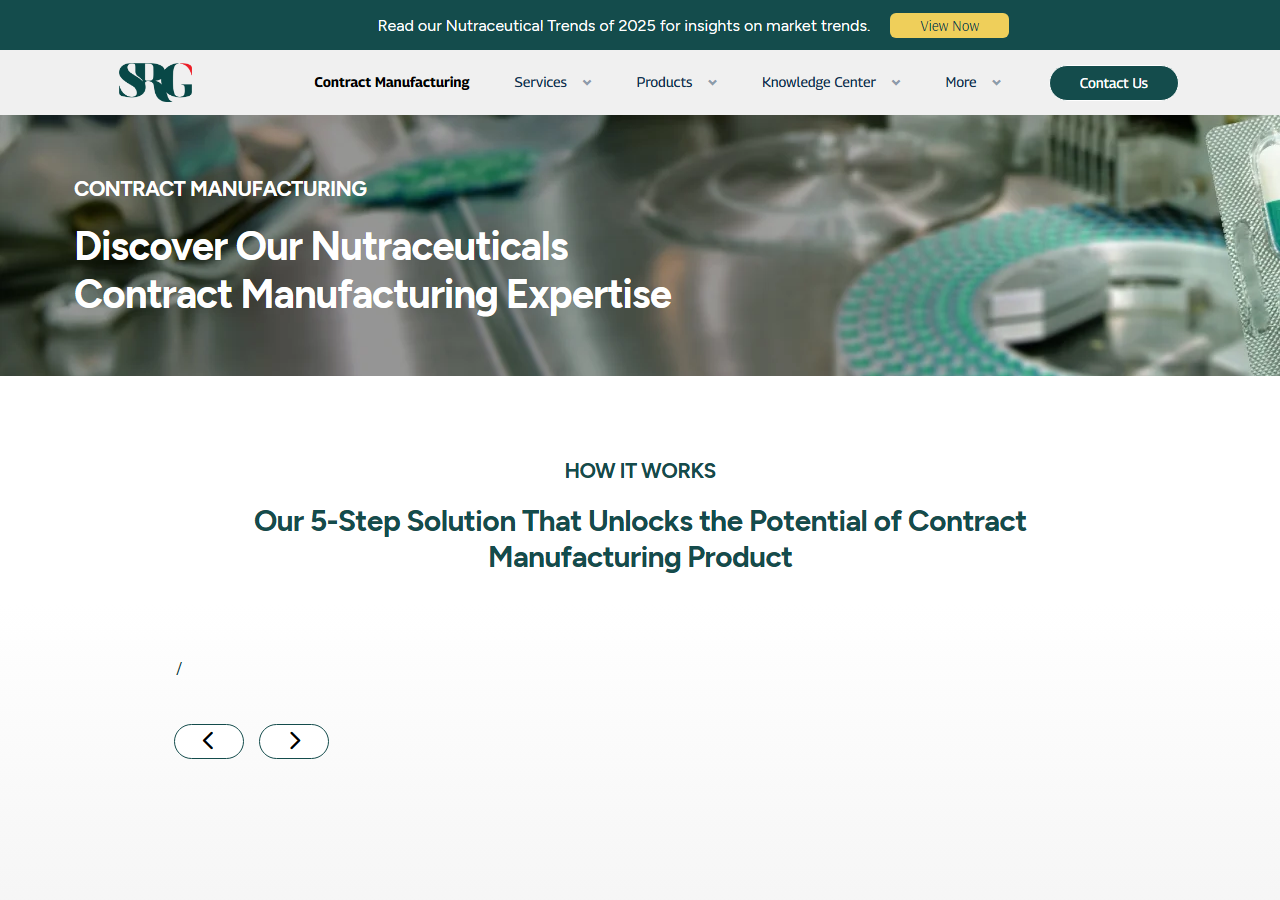
Simpang Ampat, Pulau Pinang · Nutraceutical contract manufacturer · Established 2007
Sky Nutraceuticals is one of the few Malaysian contract manufacturers that treats beauty and anti-ageing supplements as a headline category rather than an afterthought, alongside functional food and beverage, weight management and general wellness. Operating from Bukit Minyak in Penang since 2007, it states GMP and Halal certification together with ISO 22716, ISO 22000, ISO 9001 and ISO 14001, and lists offices in Singapore, Jakarta and the United States. For a brand whose entire proposition is the supplement itself, this is the most natural first conversation on the list — with the caveat that a topical range would need a separate partner.
2. Top Green Health Supplements Sdn. Bhd. — the widest published beauty menu
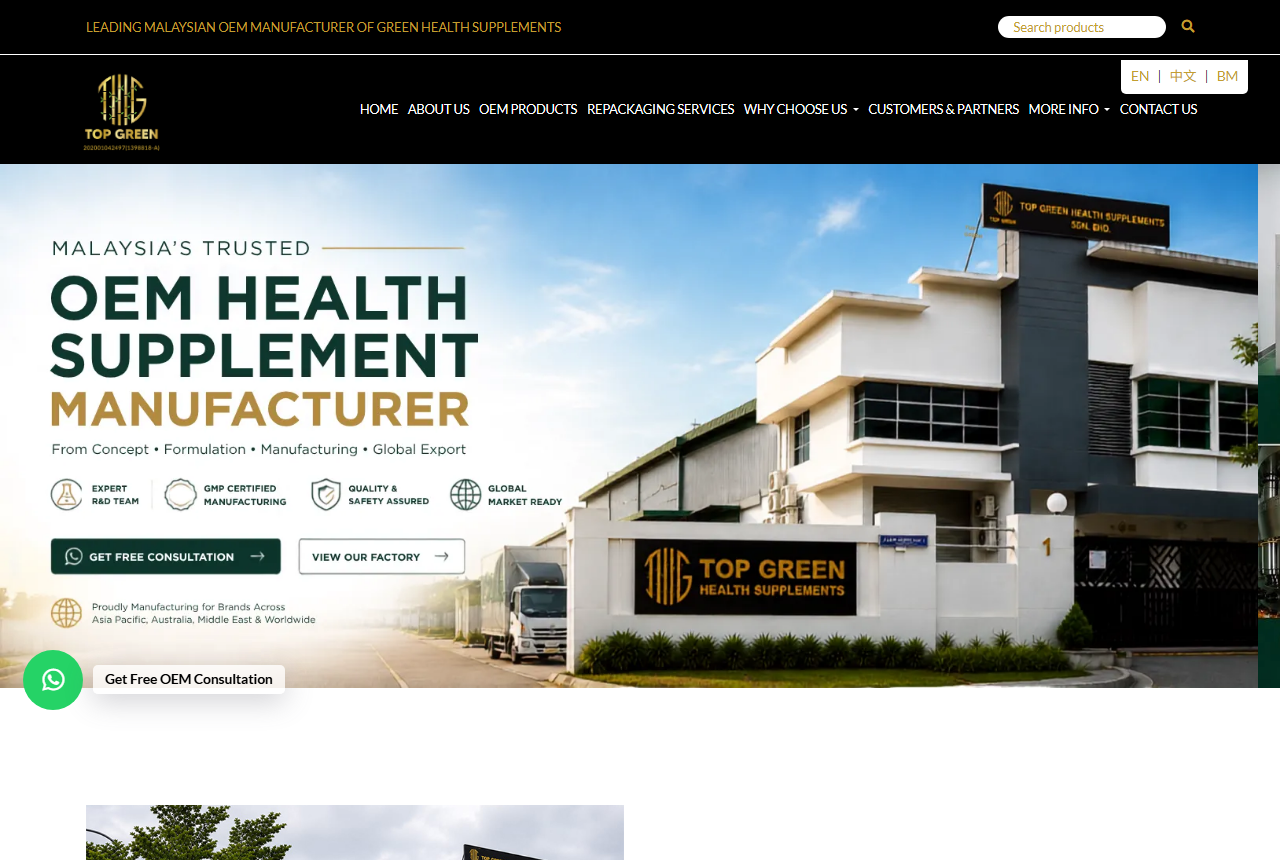
Semenyih, Selangor · Health supplement OEM and private label manufacturer
Top Green publishes an unusually granular beauty-supplement menu: collagen and hyaluronic acid formulas, whitening and brightening blends, anti-ageing and skin-hydration products, UV-protection formulas and probiotics for skin health, across capsules, tablets, powders, sachets, functional drinks and gummies. It states HALAL, GMP and MeSTI certified facilities at Semenyih and says it manufactures for brands across Asia Pacific, Australia and the Middle East. The in-house gummy and functional-drink capability deserves attention if you are targeting younger buyers, where the format frequently sells the product before the actives do.
3. D&O | ORIZI Group — a nutraceutical arm inside a full-service group
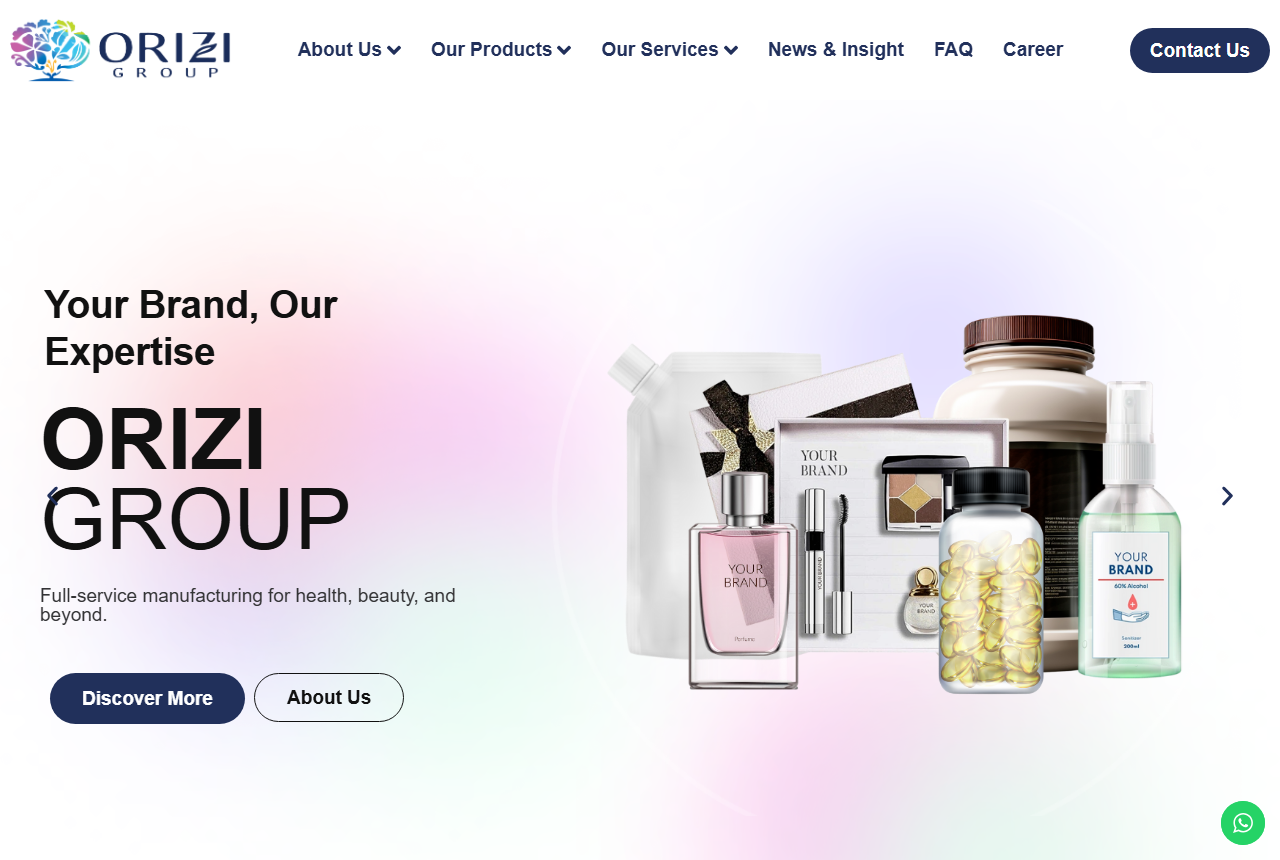
Malaysia · Nutraceutical arm of a full-service OEM/ODM group
D&O Nutraceutical Manufacturing is ORIZI Group’s nutraceutical arm, positioned specifically around nutritional powders and collagen drinks in ready-to-drink bottle and sachet formats rather than the group’s wider beauty range. It states GMP certification under NPRA and JAKIM Halal certification, and markets in-house R&D for custom formulas, flexible MOQ and fast sampling cycles — a combination aimed squarely at brands that cannot underwrite a large first run. Its distinctive draw is group breadth: a brand wanting a collagen drink plus a matching skincare line can keep both inside one organisation, while a brand that only makes ingestibles may prefer a dedicated nutraceutical house.
4. ORi Bionature (M) Sdn. Bhd. — collagen beverages and a channel specialism
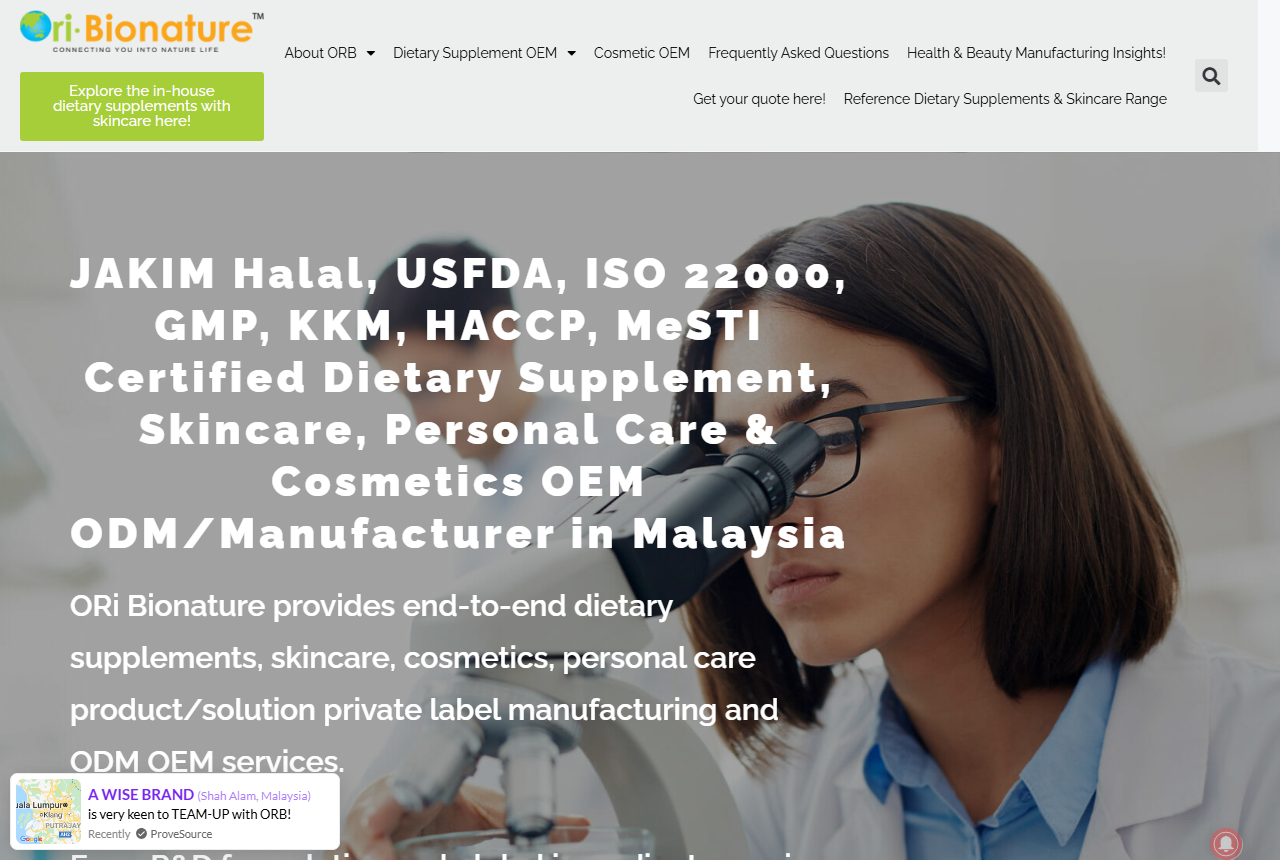
Malaysia · OEM, private label and contract manufacturer — health and cosmetic
ORi Bionature describes more than 15 years supplying dietary supplements, skincare, cosmetics and personal care, with a stated specialism serving multi-level marketing firms across South East Asia. That channel focus is worth understanding before you engage, because MLM packaging, margin structures and reorder patterns differ from retail or e-commerce. For nutricosmetics it produces cosmetic collagen beverages and wellness juices positioned around slimming and anti-ageing. It lists JAKIM Halal, USFDA, ISO 22000, GMP, KKM, HACCP and MeSTI credentials, and offers registration assistance for Health Supplement (MAL) and Traditional Herbs Supplement (MAL) filings — directly relevant to the timeline problem described above.
5. Bionutricia Holding Sdn. Bhd. — format engineering depth
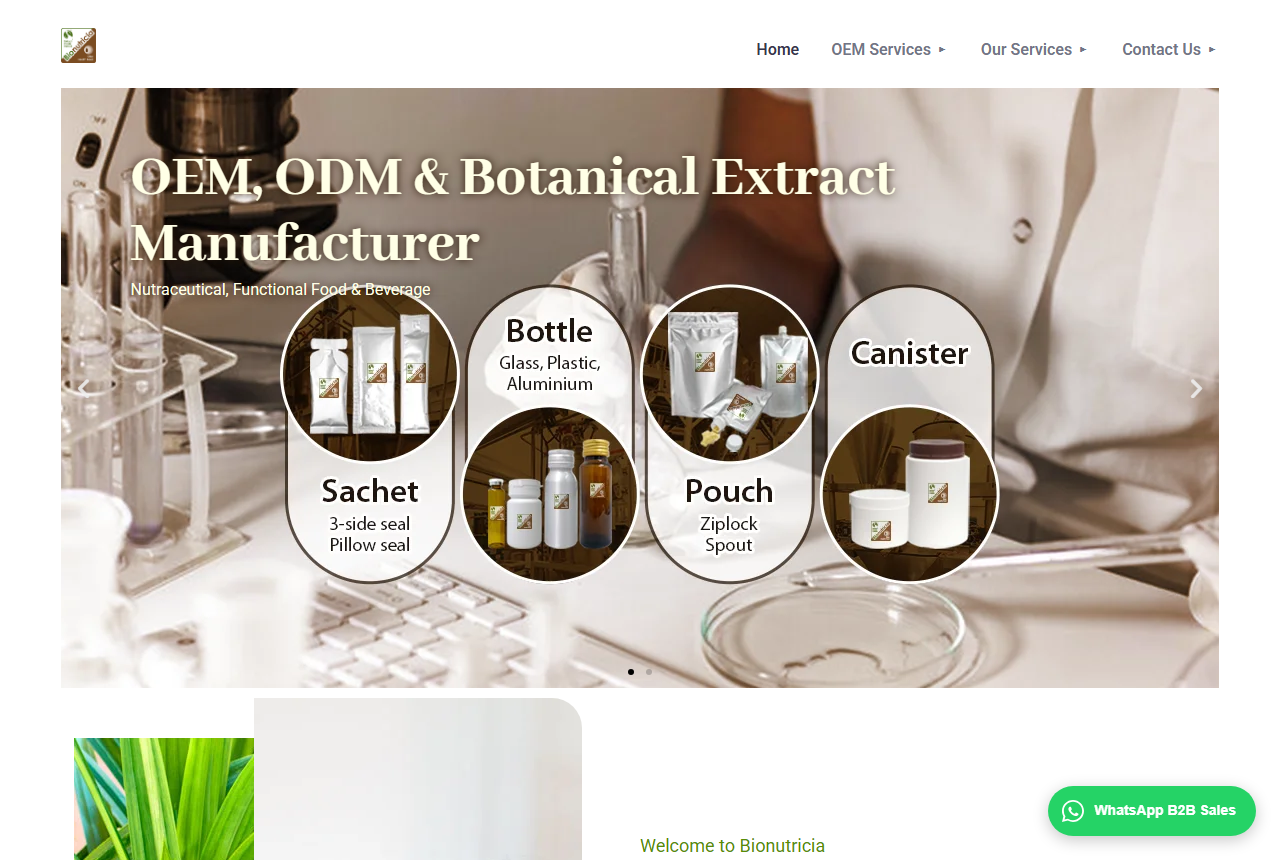
Sungai Buloh, Selangor · Private label and OEM nutraceutical manufacturer · Founded 2006
Bionutricia is the strongest format engineer here rather than a declared beauty specialist: powder, liquid and gel sachets, pouch beverages, chewable tablets and liquid bottles, supported by in-house contract extraction and spray-drying and formulation input from registered pharmacists, nutritionists and dietitians. It states FSSC 22000, GMP, HACCP, JAKIM MAL Halal, US FDA registration and MeSTI, and reports more than 239 brand partners. Because its public materials do not foreground collagen or beauty lines, approach a nutricosmetic brief here as a custom development conversation and ask directly for comparable past work.
MOQ and sampling: what to expect and what to ask
There is no universal MOQ for a Malaysian collagen drink, and any number presented as universal should be treated sceptically. The variables that actually move it are format, packaging and whether you take an existing house formulation or commission a new one. A stock formula in a standard three-side-seal sachet can start at a fraction of the commitment required for a custom ready-to-drink bottle, which carries its own filling setup and stability testing. D&O (ORIZI Group) is among those explicitly marketing flexible MOQ and fast sampling for smaller brands, which is often the deciding factor for a first launch.
On sampling, insist on clarity about what a sample represents. A bench sample made in a lab is not evidence that the formula survives a production run, and a pilot batch is not evidence of stability at month twelve. Ask what the sample cost covers, whether it is credited against your first order, and critically whether the sample is made on the same line that will make your production batch. Send the same written brief to at least three factories; quotes built on different assumptions are not comparable, and most disappointing quotes are really briefing failures.
NPRA registration and Halal: the two gates that set your launch date
Plan your launch backwards from registration rather than from production capacity. Health supplement registration with the NPRA is the critical path for most first-time nutricosmetic brands, and it is where optimistic launch dates go to die. Clarify early whether your manufacturer files on your behalf or simply hands you documentation to file yourself — the difference is weeks of work and a meaningful shift in who owns the risk if the dossier comes back with queries.
Halal is the second gate. It is not legally mandatory, but for the Malaysian domestic market and for export to Indonesia or the Gulf it is commercially close to essential — and it matters more for ingestibles than for topicals, because collagen is frequently porcine- or bovine-derived. This is a large part of why marine collagen from sources such as tilapia is so common in this category. Every factory profiled here states JAKIM Halal certification or capability; the question to ask is whether the certificate covers your specific product and raw materials, not merely the facility. Guidance changes, so verify current requirements with NPRA and JAKIM directly rather than relying on any article, including this one.
Cost and lead time: where the money actually goes
Brand owners tend to budget for unit cost and underbudget for everything surrounding it. In a nutricosmetic project the recurring surprises are stability testing, claim substantiation, artwork revisions against regulatory feedback, and the working capital tied up while a MAL application sits in the queue. None of these appear on a per-unit quotation, and all of them are real.
Lead time behaves similarly. Production may be measured in weeks, but the path from signed brief to shelf is usually measured in months once registration is included. Build that into your marketing calendar before you commit to a campaign date or a retailer listing. If you are weighing sourcing decisions across a wider range, our Cosmetics, Skincare & Personal Care guides cover the adjacent categories, and our list of private label skincare companies in Malaysia is a useful companion if a topical range sits alongside your supplement.
For startups and low-MOQ launches
If you are launching small, the honest advice is to reduce variables rather than chase the lowest unit price. Start from an existing house formulation instead of a bespoke one; choose a sachet or capsule over a custom-moulded bottle; and prioritise a factory that will actually answer your questions at a small order size, because responsiveness at 5,000 units predicts responsiveness at 50,000. Factories marketing flexible MOQ and fast sampling, such as D&O (ORIZI Group), exist precisely for this stage of a brand.
It is also worth being realistic about what a first run is for. It is a market test, not an empire. Brands that over-order their first batch usually do so because a marginally better unit price felt like a win, and then spend a year discovering that cash tied up in stock is the most expensive discount available. Order the smallest quantity that lets you learn something true about demand.
Who we left out, and why
Four Malaysian manufacturers deserve a note, and the last two are the most instructive. Esprit Care Sdn. Bhd. in Puchong is a substantial GMP-certified manufacturer across capsules, powders, probiotics and oral sprays, stating four GMP-certified sites — but its published range centres on therapeutic health supplements, functional food and pet supplements, with no verifiable beauty or collagen line. It fails a relevance screen, not a quality one, and would be a sensible candidate for a general health supplement brief. Produxpro markets itself as an OEM health supplement manufacturer serving the health and beauty industry, but its site did not return content we could verify in July 2026.
TCT Nutraceuticals is a well-known Malaysian manufacturer whose name invites the assumption of a supplement line; its business is cosmetics and skincare manufacturing, so it sits outside an ingestibles list. MM Cosmetic Sdn. Bhd. in Ulu Tiram, Johor, markets a detailed collagen drink programme and several supplement formats, but it is a cosmetics manufacturer by trade and we could not verify that the ingestible line is produced in-house rather than arranged through a third party. Both are capable, established businesses — and both are exactly the kind of company a brand owner shortlists by mistake, on the strength of a name or a well-written product page. In this category neither is a capability statement.
We also excluded the many cosmetics OEMs that advertise supplements without evidence of in-house ingestible production. Arranging a supplement through a third party is a materially different proposition from manufacturing one, and the distinction becomes important precisely when something goes wrong with a batch.
Frequently asked questions
Do beauty supplements need NPRA approval in Malaysia?
Yes, and it is a heavier process than for cosmetics. Ingestible products such as collagen drinks and skin-health capsules are regulated by the NPRA as health supplements, requiring product registration and a MAL number, rather than the lighter notification route used for topical cosmetics. Dossier requirements and timelines are meaningfully longer. Most manufacturers offer registration assistance, but confirm whether they file on your behalf or only supply documentation, because that difference directly affects your launch date and who carries the risk.
Can one Malaysian factory make both my collagen drink and my skincare range?
Some organisations can, though fewer than marketing pages imply, and rarely in one building. Ingestibles and topicals are produced under different certifications and generally in separate facilities, so genuine dual capability normally means two qualified operations under one group. Among the factories here, D&O (ORIZI Group) and ORi Bionature sit within groups publishing both ingestible and topical ranges. Request the certification scope for each product type separately — a GMP certificate covering a cosmetic line does not automatically cover a supplement line, and a group owning both arms still has to evidence each one.
Is marine collagen necessary for a Halal-certified beauty supplement?
Not strictly, but it removes the most common obstacle. Collagen is frequently porcine- or bovine-derived, and porcine sources are not acceptable for Halal certification while bovine sources require Halal-certified slaughter documentation through the supply chain. Marine collagen, typically from tilapia, sidesteps much of that complexity, which is a significant reason it is so widespread in this category in Malaysia. Confirm that any Halal certificate covers your specific raw materials and finished product rather than only the manufacturing facility.
What MOQ should I expect for a collagen drink in Malaysia?
There is no single figure, and one quoted as universal deserves scepticism. MOQ moves with format, packaging and whether you adopt a house formulation or commission a custom one — a stock formula in a standard sachet starts far lower than a bespoke ready-to-drink bottle needing its own filling setup and stability testing. Some manufacturers, including D&O (ORIZI Group), market flexible MOQ for smaller brands. Request quotes from at least three manufacturers against an identical written brief, or the numbers will not be comparable.
All capabilities, certifications and MOQ statements described above are as published by each company and have not been independently audited. Certification status and regulatory requirements change — verify current NPRA registration requirements and JAKIM Halal scope directly with the authorities and with each manufacturer before committing to any supplier. Screenshots captured from each company’s official website in July 2026.
About the author
Arif Hakim is a regulatory and compliance specialist who writes about Malaysian OEM manufacturing, product registration and Halal certification for brand owners.