
By Zahid Osman · Manufacturing Partnerships Editor · Published 2 Oct 2026
Three Bursa-linked aesthetic businesses publish enough numbers to show how Malaysia’s clinic and beauty-centre skincare market really works: DC Healthcare (Dr Chong Clinic), Salcon’s Bloom Healthcare, and 1 Doc International, which has a draft prospectus out. We set their figures against our own count of clinic-owned brands.
Article type: Market insight (business analysis) · Scope: Malaysia, medical aesthetic clinics, beauty centres and their own-brand skincare · Research period: 3–25 September 2026 · Written by: Zahid Osman · Fact-checked by: Farah Zainal · Last reviewed: 25 September 2026 · Corrections: via the Contact page
Quick answer
Malaysia’s listed aesthetic players show that clinic skincare is mostly an add-on to treatments, not a stand-alone business. The exception is the high-volume beauty-centre model. At DC Healthcare (Dr Chong Clinic), skincare was 4.6% of FY2025 revenue (RM4.0m of RM87.0m). At 1 Doc International, a non-medical beauty-centre chain whose Main Market IPO is still in draft, product sales were 17.5% of FY2024 revenue (RM60.7m of RM347.0m), at gross margins above 84%. Salcon does not break out Bloom Healthcare’s product sales. Our scan of 733 Malaysian chains and specialist clinics found 168 with their own NPRA-notified skincare and 3,164 products, of which only 42.8% are made in Malaysia. Figures are dated and sourced below. This analysis is not investment advice.
Key takeaways
- The operating model decides the product share. In a doctor-led aesthetic clinic, products are about 5% of revenue (DC Healthcare). In a beauty-centre chain selling packages and take-home ranges, they are 17–19% (1 Doc).
- Products earn the highest margin in the business. 1 Doc’s product lines had gross margins of 84.8%–91.9% in FY2024, against 76.7%–82.6% for its services (draft prospectus s.12.3.5).
- Profitability varies widely. FY2024: 1 Doc PAT margin 28.0%. FY2025: DC Healthcare PBT margin 1.9%, and Salcon’s Healthcare Division a pre-tax loss equal to 64% of its revenue.
- Most clinic-owned products are not made here. Across 3,164 clinic-owned products we matched on NPRA, 42.8% are made in Malaysia. The listed players are more local: 68% at DC Healthcare, 97% at 1 Doc, 100% at Bloom.
- Relying on one supplier is a disclosed risk. 1 Doc buys 51%–69% of its input products from a single contract manufacturer. It keeps ownership of the formulations and has non-supply agreements in place.
Who this is for
This piece is for clinic and beauty-centre owners deciding whether a house skincare line is worth it, brand founders and suppliers sizing the clinic channel, and analysts who want the listed players’ numbers in one dated, sourced place. The company-by-company detail is in our DC Healthcare profile and our Salcon / Bloom Healthcare profile.
Who are the listed players, and how do they compare?
There are three Bursa-linked businesses with aesthetic or beauty-centre operations and usable disclosures. They run three different models: a doctor-led clinic chain, a multi-specialty roll-up, and a non-medical beauty-centre chain. We compare them on the same criteria and write “not disclosed” where a company does not publish a figure.
| Criterion | DC Healthcare (Dr Chong Clinic) | Salcon Bhd / Bloom Healthcare | 1 Doc International (One Doc, Hair Doc, Slim Doc, Perfect Doc) |
|---|---|---|---|
| Listing status | ACE Market, code 0283, since 17 Jul 2023 | Listed parent (diversified engineering group) | Main Market application; SC prospectus exposure draft, May 2026, not yet listed at 25 Sep 2026 |
| Operating model | Medical aesthetic clinics; company states doctors are LCP-credentialed | Dental, GP, aesthetic and spa network | Non-medical beauty services by beauticians, regulated under KPDN guidelines (company-stated) |
| Outlets | 23 Dr Chong Clinic outlets (end-2025) | 83 facilities incl. 10 aesthetic (end-2025) | 57: 53 Malaysia + 4 Singapore (latest practicable date) |
| Latest full-year revenue | RM87.0m (FY2025) | Healthcare RM26.5m (FY2025) | RM347.0m (FY2024) |
| Latest full-year profit | PBT RM1.64m; PAT RM0.21m | Healthcare LBT RM17.1m | PBT RM132.5m; PAT RM97.1m |
| Own-brand product sales | RM3.97m (4.6%) | not disclosed | RM60.7m (17.5%) |
| House brands | newB Premium, Plant PDRN, Le Perfetto, Dreamskin | DermDefine | One Doc, Hair Doc, Slim Doc (SD), Perfect Doc, Cellaxy, Peptric |
| Active NPRA notifications | 34 | 9 | 115 |
| Made in Malaysia (per NPRA) | 68% (rest Japan) | 100% | 97% (rest South Korea) |
| Main source document | Annual Report 2025 | Integrated Annual Report 2025; Q2 2026 interim report | Draft prospectus (1doc exposure), s.7, 8, 12 |
NPRA figures: Quest3+ snapshot 3–5 Sep 2026, verified by holder name. 1 Doc PBT derived from its 38.19% FY2024 PBT margin. 1 Doc figures are from an unregistered draft and may change in the final prospectus.
How much do products really contribute?
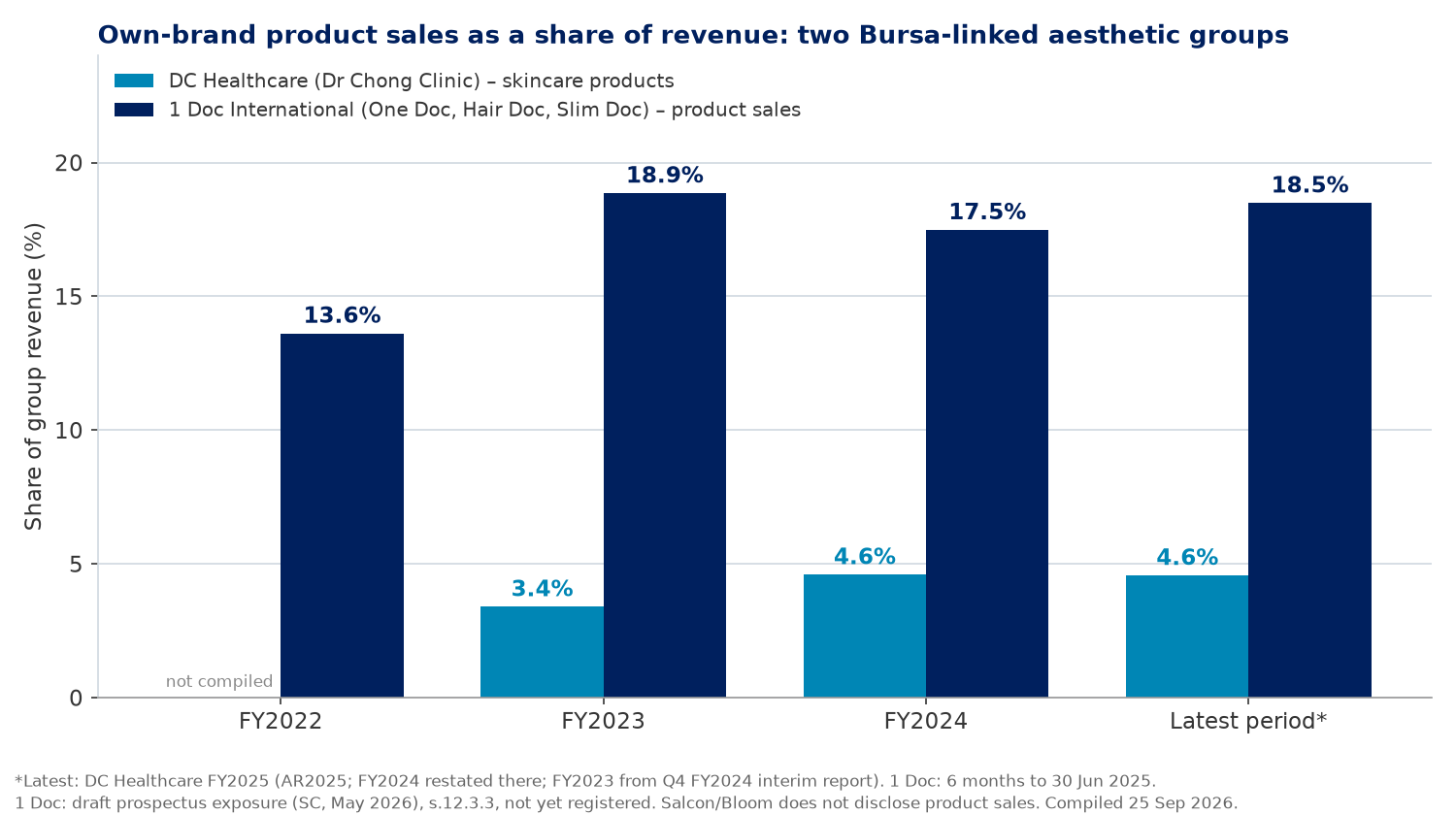
At a medical aesthetic clinic, products bring in a small share of revenue. At a beauty-centre chain, the share is roughly four times higher, because packages and take-home ranges are sold together at every visit.
| Company · period | Product sales (RM m) | Share of revenue | Source |
|---|---|---|---|
| DC Healthcare · FY2023 | 2.30 | 3.4% | Q4 FY2024 interim report, note A9 |
| DC Healthcare · FY2024 | 2.56 | 4.6% | AR2025 (restated) |
| DC Healthcare · FY2025 | 3.97 | 4.6% | AR2025, revenue by segment |
| 1 Doc · FY2022 | 26.10 | 13.6% | Draft prospectus s.12.3.3 |
| 1 Doc · FY2023 | 57.02 | 18.9% | Draft prospectus s.12.3.3 |
| 1 Doc · FY2024 | 60.66 | 17.5% | Draft prospectus s.12.3.3 |
| 1 Doc · 6M to 30 Jun 2025 | 37.85 | 18.5% | Draft prospectus s.12.3.3 |
1 Doc product sales = the sum of “sales of body care / facial care / hair care and related products”. Our calculation from the segment table.
Why the gap? Three reasons, all from the filings:
- What is being sold. DC Healthcare earns most of its revenue from doctor-performed treatments (87% in FY2025), and products are used mainly for after-treatment care (company-stated). 1 Doc runs body, facial and hair programmes where products are part of every package. Its FY2024 body-care line alone sold RM22.6m of products.
- Cost base. Doctors cost more than beauticians. DC Healthcare’s gross margin was 56.1% in FY2025. 1 Doc’s was 81.8% in FY2024.
- Margin on products. In 1 Doc’s own breakdown, product gross margins (body 91.9%, facial 87.5%, hair 84.8% in FY2024) are above every service line. Each product sale adds more to profit than a service sale does, which gives chains a strong reason to keep selling take-home ranges.
Why are profits so different?
With roughly similar outlet counts, the three are at different stages. 1 Doc is a mature, cash-generating beauty chain. DC Healthcare is a medical chain just back in profit. Bloom is a roll-up still paying start-up costs.
| Company · period | Revenue (RM m) | Margin | Source |
|---|---|---|---|
| 1 Doc · FY2024 | 346.96 | PAT 28.0%; GP 81.8% | Draft prospectus, summary financials |
| 1 Doc · 6M to 30 Jun 2025 | 204.86 | PAT 33.0% | Draft prospectus |
| DC Healthcare · FY2025 | 87.00 | PBT 1.9%; GP 56.1% | AR2025 p.7 |
| DC Healthcare · 1H FY2026 | 43.98 | PBT ≈2.2% (RM0.99m) | Q1 and Q2 FY2026 releases, May and Aug 2026 |
| Salcon Healthcare · FY2025 | 26.52 | LBT −64.5% | Salcon IAR2025 segmental table |
| Salcon Healthcare · 1H FY2026 | 24.53 | LBT −48.9% | Salcon Q2 2026 interim report |
Three patterns stand out:
- Prepaid packages create timing risk. Both DC Healthcare and 1 Doc sell treatment packages in advance. DC Healthcare’s FY2024 loss came with a “lower redemption rate”, and contract liabilities rose to RM18.54m (Q4 FY2024 report). Cash coming in and revenue being booked can move far apart.
- New outlets take time to pay off. Salcon says most of its new outlets are less than six months old and losses should narrow as they mature (Q2 2026 interim report). Its own impairment test assumes a 6%–22% EBITDA margin for the mature healthcare unit (IAR2025 note 5).
- The medical and beauty models are converging. 1 Doc’s draft prospectus sets aside IPO proceeds to acquire medical aesthetic clinics that will fall under the Ministry of Health (MOH) and to recruit LCP-accredited doctors (s.4.4). The beauty-centre leader plans to add the doctor-led model, while DC Healthcare is adding slimming and wellness to its clinics.
LCP means the MOH Letter of Credentialing and Privileging a registered doctor needs to carry out aesthetic medical procedures. Beauty centres that do not break the skin or use restricted substances fall under Ministry of Domestic Trade and Cost of Living (KPDN) guidelines instead (1 Doc draft prospectus, s.7 and s.8).
How big is the market these players compete in?
There is no official figure for aesthetic-clinic revenue. The best public estimate is for the wider beauty-services market, and 1 Doc’s draft prospectus puts it at RM5.84 billion in 2024. That figure is household spending on hairdressing and personal grooming (RM53.43 a month × 9.1 million households × 12). It was prepared by Vital Factor Consulting from Department of Statistics Malaysia (DOSM) data (IMR report, s.8), and on that basis 1 Doc’s share is 6%. The same report counts 13,957 “hair dressing and other beauty treatment” establishments in 2022 (DOSM). DC Healthcare’s annual report cites industry research projecting an 18.8% CAGR for Malaysian aesthetic medical services, 2021–2027 (company-cited, source not named in the report).
The IMR report’s peer table shows how far the top chain is ahead of the rest. Operators with at least 10 centres and more than RM1m revenue, latest audited year:
| Operator (brand) | FYE | Revenue (RM m) | PAT/(LAT) margin | Centres (MY) |
|---|---|---|---|---|
| 1 Doc Group (One Doc, Hair Doc, Slim Doc, Perfect Doc) | Dec-24 | 346.96 | 28.0% | 53 |
| Esthetics International Group Bhd (AsterSpring), Main Market | Mar-25 | 183.63 | (4.8%) | 30 |
| London Weight Management | Mar-25 | 95.95 | 18.4% | 15 |
| Dorra Slimming | Mar-25 | 91.36 | 22.8% | 12 |
| New York Skin (New York Skin Solutions) | Mar-25 | 83.37 | 8.4% | 15 |
| Skin Essentials (HerbaLine) | Dec-24 | 67.32 | 4.8% | 47 |
| Estika Medispa Holdings (Estika Medispa) | Dec-24 | 19.11 | 2.2% | 34 |
| Hannan Medispa | Dec-23 | 17.39 | 13.5% | 126 |
Source: IMR report “Beauty Industry in Malaysia”, 19 Dec 2025, reproduced in 1 Doc draft prospectus s.8 (Companies Commission of Malaysia (SSM) filings; financials may include other activities; centre counts at operating-brand level). Medical clinic groups such as DC Healthcare (FY2025 revenue RM87.0m) are not in this beauty-centre table. Different financial years are not directly comparable.
Our reading: after 1 Doc, the market is fragmented. The next operators earn RM20m–RM185m, and many brands with 100-plus outlets (Hannan Medispa, 126 centres) earn well under RM20m. Revenue per outlet varies by more than ten times between models, and that matters more than outlet count when you size a supplier opportunity.
What does our clinic-to-brand scan add?
Most clinics have no NPRA-notified brand of their own. Of those that do, fewer than half make their products in Malaysia. We built a list of clinics from Google Maps and then matched each chain to NPRA holders by company name, address, phone and email domain.
| Step | Result | Date |
|---|---|---|
| Google Maps listings captured (dermatology, aesthetic, medispa, facial/beauty, dental, GP, plastic surgery) | 15,507 listings, incl. 1,515 aesthetic clinics, 521 medispas, 215 dermatology, 104 plastic surgery | 24–25 Sep 2026 |
| Chains and specialist clinics checked against NPRA | 733 | 25 Sep 2026 |
| Chains with their own NPRA-notified skincare | 168 (23%), held by 152 notification holders | NPRA snapshot 3–5 Sep 2026 |
| Products under those holders | 3,164 | same |
| Made in Malaysia | 42.8%; the rest imported (notably Spain, Singapore, Germany, South Korea, Taiwan, China) | same |
Across the whole segment, then, a clinic-owned skincare brand is not the norm: about three in four chains we checked have none. Clinics that do have one often buy imported private label rather than making it locally. The listed players are more local than the segment average (68%–100% against 42.8%), probably because scale makes locally developed formulas worth the effort.
What should clinic owners and suppliers take from this?
Clinic and beauty-centre owners
- Set targets that match your model. For a doctor-led clinic, 4%–5% of revenue from products is what a 20-plus-outlet listed chain achieves. Package-driven beauty centres reach 17%–19%.
- Own your formulas. 1 Doc says in its draft prospectus that owning the formulations means it could switch manufacturers even though one supplies more than half its inputs. Put formula ownership and non-supply clauses in the contract.
- Notify before you sell. Every SKU needs an NPRA notification, and a product made in two factories needs two. See our NPRA notification guide.
- Start with products your treatment rooms use. Bloom’s first DermDefine range began with gels and masks used in treatments plus a short take-home regimen. It is a lower-risk first step than a full retail line.
Suppliers and contract manufacturers
- Expect small, frequent orders from clinic chains unless the client runs a package-heavy beauty model. Our private-label cost guide shows how MOQ and unit cost interact.
- Be ready for clients who split sourcing. DC Healthcare imports its premium tier from Japan and makes its basics locally. A local manufacturer’s case is usually strongest on regimen basics, lead time and speed of notification.
- Plan for concentration from both sides. A contract manufacturer can end up heavily dependent on one chain. Per NPRA, about half of one contract manufacturer’s 207 notified products belong to a single beauty group. That is as much a risk for the manufacturer as for the client.
For the practical launch sequence, see our step-by-step guide to launching a private-label skincare brand in Malaysia. For the wider context, see Malaysia cosmetics OEM trends to watch in 2026.
FAQ
Which aesthetic companies are listed on Bursa Malaysia?
DC Healthcare Holdings (Dr Chong Clinic) is listed on the ACE Market. Salcon Berhad owns the Bloom Healthcare network (Cantiq, Aessence and dental brands). Esthetics International Group, the parent of the AsterSpring beauty chain, is on the Main Market. 1 Doc International has filed a draft prospectus for the Main Market but was not listed as at 25 Sep 2026.
How much do aesthetic clinics earn from selling skincare?
It depends on the model. DC Healthcare, a doctor-led chain, earned 4.6% of FY2025 revenue from skincare (RM3.97m). 1 Doc, a beauty-centre chain, earned 17.5% of FY2024 revenue from product sales (RM60.7m). Most clinics do not disclose this, so check annual reports or segment notes where they exist.
Is 1 Doc International a medical aesthetic company?
Not at present. Its draft prospectus states that its services are non-medical beauty services performed by beauticians and regulated under KPDN guidelines, not by MOH. It plans to use part of its IPO proceeds to acquire medical aesthetic clinics with LCP-accredited doctors.
What is the size of Malaysia’s beauty services market?
An IMR report in 1 Doc’s draft prospectus estimates RM5.84 billion for 2024, based on DOSM household spending on hairdressing and personal grooming. There is no official figure for medical aesthetic clinics alone, so treat any single number with care and check what it includes.
Do most Malaysian clinics have their own skincare brand?
No. In our scan of 733 chains and specialist clinics (September 2026), 168 (23%) had their own NPRA-notified products. Dental chains almost never do, while aesthetic clinics and medispas account for most of the brands. You can check any brand on NPRA’s Quest3+ search.
Where are clinic-owned skincare products made?
Across the 3,164 clinic-owned products we matched, 42.8% are made in Malaysia and the rest are imported. The listed players make more locally: DC Healthcare 68%, 1 Doc 97% and Bloom’s DermDefine 100% (NPRA snapshot 3–5 Sep 2026).
Why are margins so different between these companies?
Mostly because of the operating model and the stage each business is at. Beauty centres staffed by beauticians have lower costs than doctor-led clinics, and new roll-ups carry start-up losses. In FY2024, 1 Doc’s PAT margin was 28.0%. In FY2025, DC Healthcare’s PBT margin was 1.9% and Salcon’s Healthcare Division ran a loss.
Sources and evidence
- DC Healthcare Holdings Bhd, Annual Report 2025 and Q4 FY2024 interim report. Q1 FY2026 and Q2 FY2026 releases.
- Salcon Berhad, Integrated Annual Report 2025 and Q2 2026 interim report.
- Securities Commission Malaysia, Prospectus exposure: 1 Doc International Berhad (draft, May 2026): s.4.4 use of proceeds; s.7 business overview (suppliers, regulation); s.8 IMR report by Vital Factor Consulting (19 Dec 2025); s.12 financial information.
- The Star, 1 Doc International eyes Main Market listing (15 Jan 2026).
- NPRA, Quest3+ cosmetic notification search: snapshot 3–5 Sep 2026.
- Ministry of Health, National Registry of Registered Medical Practitioners practising aesthetic medical practice (LCP), for the definition of LCP.
- Our datasets: Google Maps clinic listings (15,507, captured 24–25 Sep 2026) and the clinic-to-NPRA-holder match (733 chains checked, 25 Sep 2026).
Limitations
The companies disclose different things over different periods: 1 Doc’s latest full year is FY2024, while DC Healthcare’s and Salcon’s is FY2025. 1 Doc’s figures come from an unregistered draft prospectus and may change. Salcon does not separate aesthetics or product sales from its healthcare segment. The IMR market size is based on household spending, not a count of clinic revenue. Our Google Maps capture has a limit on results per search, so small towns and salons are a sample, not a full census. Chain matching to NPRA holders relies on names, addresses, phones and email domains, and a few matches may be wrong. The NPRA register shows who is notified as the manufacturer, not volumes. We did not interview the companies or audit their accounts.
Update history
| Date | Change |
|---|---|
| 2 Oct 2026 | First published. Data: DC Healthcare AR2025 and FY2026 releases; Salcon IAR2025 and Q2 2026 report; 1 Doc draft prospectus (May 2026); NPRA snapshot 3–5 Sep 2026; Google Maps capture 24–25 Sep 2026. |
About the author
Zahid Osman is the Manufacturing Partnerships Editor at MalaysiaOEM and writes about how Malaysian brands, clinics and contract manufacturers work together. Fact-checked by Farah Zainal.